Quick Buyer Summary
| Buy it if | Skip it if |
|---|---|
| You sew often enough that setup time starts to matter, and you want one machine that handles garments, repairs, and craft projects from the same bench. | You need a machine that stores easily, travels often, or stays simple enough for occasional use without extra learning. |
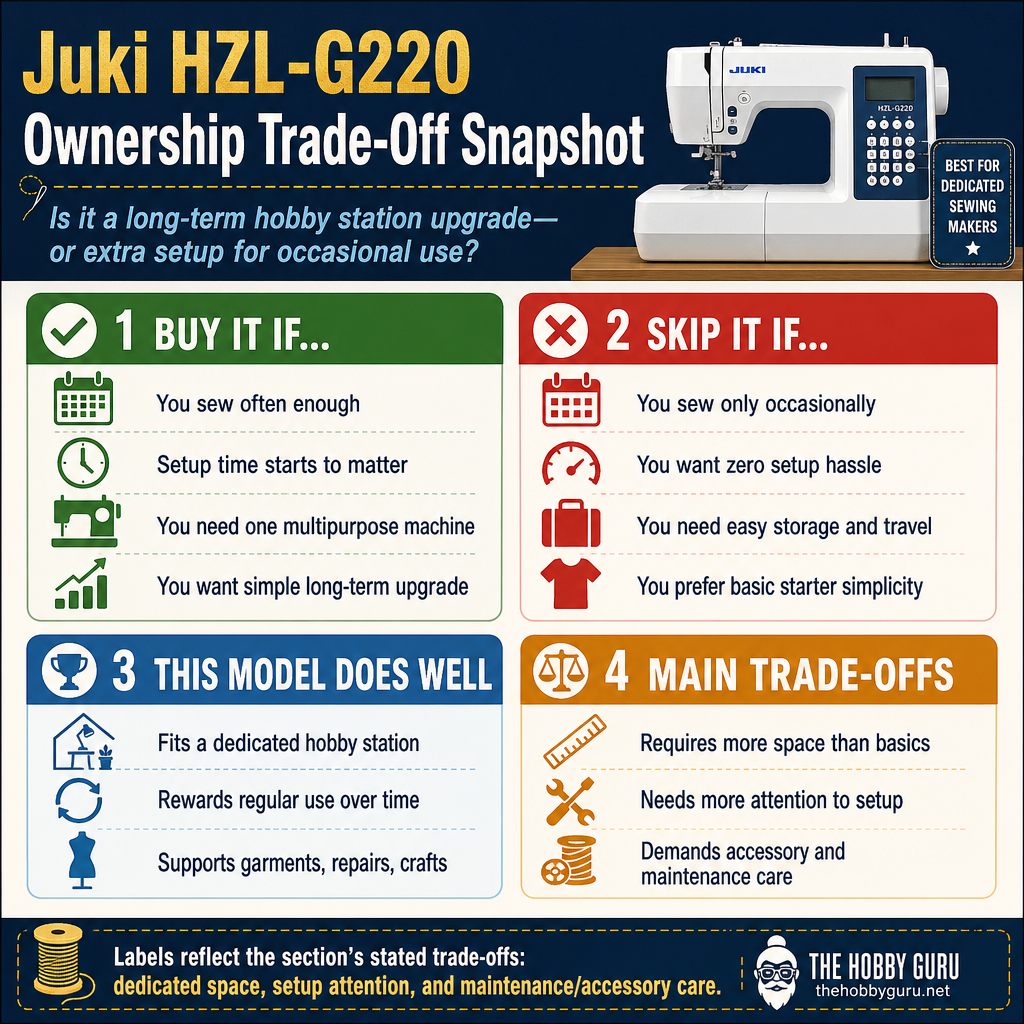
What this model does well: it fits a dedicated hobby station, rewards regular use, and makes more sense as a long-term upgrade than as a quick purchase for a few seams a month.
Main trade-offs: it asks for more space, more attention to setup, and more care around accessories and maintenance than a basic starter machine.
How We Judged It
The listing details do not settle the decision by themselves, so the real question is workflow fit. The useful clues here are the machine’s place in a premium hobby setup, the amount of storage and table space it needs, and whether the buyer wants an all-purpose tool or a narrower specialty machine.
That shifts the focus to maintenance burden and ownership friction. A machine in this class makes sense only when lint cleanup, correct needles, accessory storage, and service access feel like part of the plan, not an afterthought.
Used listings matter here as well. A missing foot set, pedal, bobbin case, or manual changes the value fast, and replacement accessories erase the bargain more quickly than a cosmetic scuff ever will.
Juki HZL-G220 Review: Overview
The Juki HZL-G220 belongs in the “serious home hobby” lane. It is not the right pick for a casual buyer who wants a machine that comes out of the closet once in a while and goes right back in.
Its real value sits in how it changes the sewing station. A machine like this makes sense when one setup handles mending, garment sewing, craft builds, and the kind of recurring project work that punishes flimsy controls or a cramped layout.
That also explains the biggest decision point. If the machine stays on a dedicated table, the upgrade feels practical. If it has to be lifted, packed away, and reset each time, the convenience premium drops fast.
Juki HZL-G220 Review: Regular Features
Regular features matter on this model because this is where daily frustration lives. Decorative extras do not carry a project, the basic controls do.
The buyer should focus on the common actions that shape every session:
- How fast stitch selection feels
- Whether tension and thread handling stay easy to reach
- How simple the bobbin and presser-foot workflow feels
- Whether the work area stays clear enough for routine seams and small repairs
- Whether the accessory kit is complete enough to avoid extra orders
A machine that keeps those steps straightforward wins on weeknight sewing and small repair jobs. A machine that hides them behind extra steps turns quick work into stop-and-start work.
The regular-feature trade-off is learning curve. A more capable home machine asks for a little more attention up front, and that is worth it only when the machine gets used often enough to repay the effort.
Juki HZL-G220 Review: Notable Improvement
The notable improvement here is not flash. It is control.
Compared with a basic starter machine, the HZL-G220 makes more sense when a buyer wants less fiddling between seams, more confidence on repeated projects, and a sturdier-feeling workspace overall. That matters on garment seams, quilt piecing, tote bags, costume repairs, and any project that asks for the same pass through the machine again and again.
This is the point where a premium hobby machine proves itself. It does not need to be extraordinary on one dramatic task. It needs to stay calm and consistent through the ordinary tasks that fill most sewing time.
The catch is simple: the improvement only pays off when sewing is regular. A buyer who sews twice a year never recovers the cost in convenience.
Where It Makes Sense
Best-fit scenario: a dedicated sewing table, mixed hobby projects, and a buyer who wants one machine to stay ready instead of a machine that gets unpacked for a single task.
The HZL-G220 fits best for:
- Garment sewing, hems, and mending
- Tote bags, pouches, and home-decor seams
- Quilt piecing and general fabric construction
- Costumes, school projects, and recurring repair work
- Buyers stepping up from a starter machine and wanting a more settled setup
It also fits a workbench where access matters more than portability. If the machine lives near thread storage, cutting tools, and a clear tabletop, it becomes part of a real workflow instead of a once-in-a-while appliance.
A narrower specialty still beats it in one clear case: straight-stitch-heavy sewing. If bags, topstitching, and quilting dominate the list, a dedicated straight-stitch machine like the Juki TL-2010Q gives a more focused toolset. It does not suit buyers who want decorative variety or broad all-purpose flexibility.
Where It May Disappoint
The trade-offs here are practical, not dramatic.
- Noise: A more substantial home machine belongs in a room that tolerates steady motor hum and pedal noise. It loses appeal in a shared living room or apartment corner where quiet matters.
- Weight and storage: This is not a throw-it-on-the-shelf machine. If it has to move after every session, the benefit drops.
- Learning curve: Better control usually brings more setup awareness. A casual user who wants one dial, one stitch, and done will feel that extra layer.
- Maintenance burden: Routine lint cleanup, the right needles, and organized accessories matter more here than on a basic machine. Ignore those basics and the machine stops feeling premium.
- Accessory availability: A complete foot set and easy replacement path matter. Missing parts turn a solid buy into a parts hunt.
Noise and weight deserve special attention. A machine like this belongs on a bench that stays ready. If it has to disappear after each use, the setup friction erases a lot of the value.
Compared With Nearby Options
Brother CS7000X belongs on the shortlist for buyers who want a friendlier starter setup and do not need a premium hobby machine right away. It fits occasional home sewing and lighter project work. It does not fit a buyer who wants a more substantial upgrade path and a machine that feels built for repeat use.
Juki TL-2010Q belongs on the shortlist for straight-stitch-heavy sewing, especially quilting, bag making, and topstitching. It fits a narrower job better than the HZL-G220. It does not fit a buyer who wants an all-purpose machine with broader stitch variety.
| Scenario | Juki HZL-G220 | Brother CS7000X | Juki TL-2010Q |
|---|---|---|---|
| Mixed garments, mending, and craft projects | Strong fit, the best all-around match of the three | Works for lighter use | Too narrow for an all-purpose bench |
| Budget-first starter sewing | More machine than needed | Better fit | Not the right lane |
| Straight-stitch-heavy quilting or bag work | Works, but broader than necessary | Passable for casual use | Better fit, more specialized |
| Small space or frequent storage | Poor fit | Better fit | Poor fit unless specialization matters most |
The Next Step After Narrowing Juki Hzl-G220 Sewing Machine
The next move is not more brand comparison. It is checking whether this machine matches the space and support behind it.
Confirm the table or cabinet first. Then confirm the accessory set, local service access, and replacement-foot availability. Those details decide whether the HZL-G220 feels like a smart upgrade or an expensive machine with missing support.
If the sewing list is mostly straight seams, move toward the Juki TL-2010Q instead of stretching the HZL-G220 to fit a narrow job. If the list is mixed and the machine stays on a permanent bench, the HZL-G220 keeps its appeal.
Used units deserve extra scrutiny. Ask for every foot, power cord, pedal, bobbin, and manual before the deal looks good on paper.
Buying Checklist
- The machine will live on a dedicated sewing table or cabinet.
- You sew often enough for setup time to matter.
- Your projects mix repairs, garments, and hobby builds.
- You are willing to keep up with lint cleanup and accessory organization.
- You can confirm service support and replacement parts before buying.
- You do not need a compact, grab-and-go machine.
If three or more of those points do not fit your setup, skip this model and look lower or narrower on the ladder.
Final Verdict
Buy the Juki HZL-G220 if you want a premium hobby upgrade that stays on a workbench and handles mixed sewing with less friction than a starter machine. It fits recurring projects, a dedicated space, and a buyer who values repeat-use convenience over a tiny footprint.
Skip it if you sew only occasionally, need a machine that stores and moves easily, or want the simplest possible learning curve. For straight-stitch-only work, the Juki TL-2010Q fits better. For a lower-commitment starter buy, Brother CS7000X stays the simpler route.
FAQ
Is the Juki HZL-G220 good for beginners?
Yes, for a beginner who plans to sew regularly and wants a machine that stays part of the hobby. It does not suit a casual buyer who wants the easiest possible setup and the fewest controls to learn.
Is it worth upgrading from a basic sewing machine?
Yes when the current machine feels fussy, underbuilt, or slow to set up for repeated work. The upgrade makes the most sense for people who sew enough to notice workflow changes on almost every project.
Does it make sense for quilting?
Yes for general quilting, piecing, and mixed fabric work. A straight-stitch specialist like the Juki TL-2010Q fits better when quilting and similar straight-seam work dominate the bench.
What should be checked before buying used?
Check the full accessory set, foot pedal, power cord, bobbins, manual, and service access. A missing accessory pack changes the value fast and turns a premium buy into a parts chase.
Is this a good choice for a small apartment or shared room?
No, not if the machine needs to be stored after each session or if quiet matters a lot. It fits best in a fixed sewing area where the footprint and routine noise stay acceptable.
See Also
If you are weighing this model, also compare it with Janome Memory Craft 9850: What to Know Before You Buy, Brother LS14S Sewing Machine Review: Key Things to Know Before You Buy, and Warhammer 40K Ultimate Starter Set Review: A Legacy 10th-Edition Box.
For broader context before you decide, Knit Stitch vs Purl Stitch: Which One Should You Use for Your Project? and Janome Memory Craft 400E Review: A Focused Embroidery Machine for Home Use help round out the trade-offs.