How we assessed buyer fit
The Short Answer
The Juki HZL-DX7 belongs in the workflow-first category. Most guides overrate stitch count, and that logic misses the point. The real value sits in how the machine handles frequent project changes, cleaner control, and repeat use without turning every session into a setup chore.
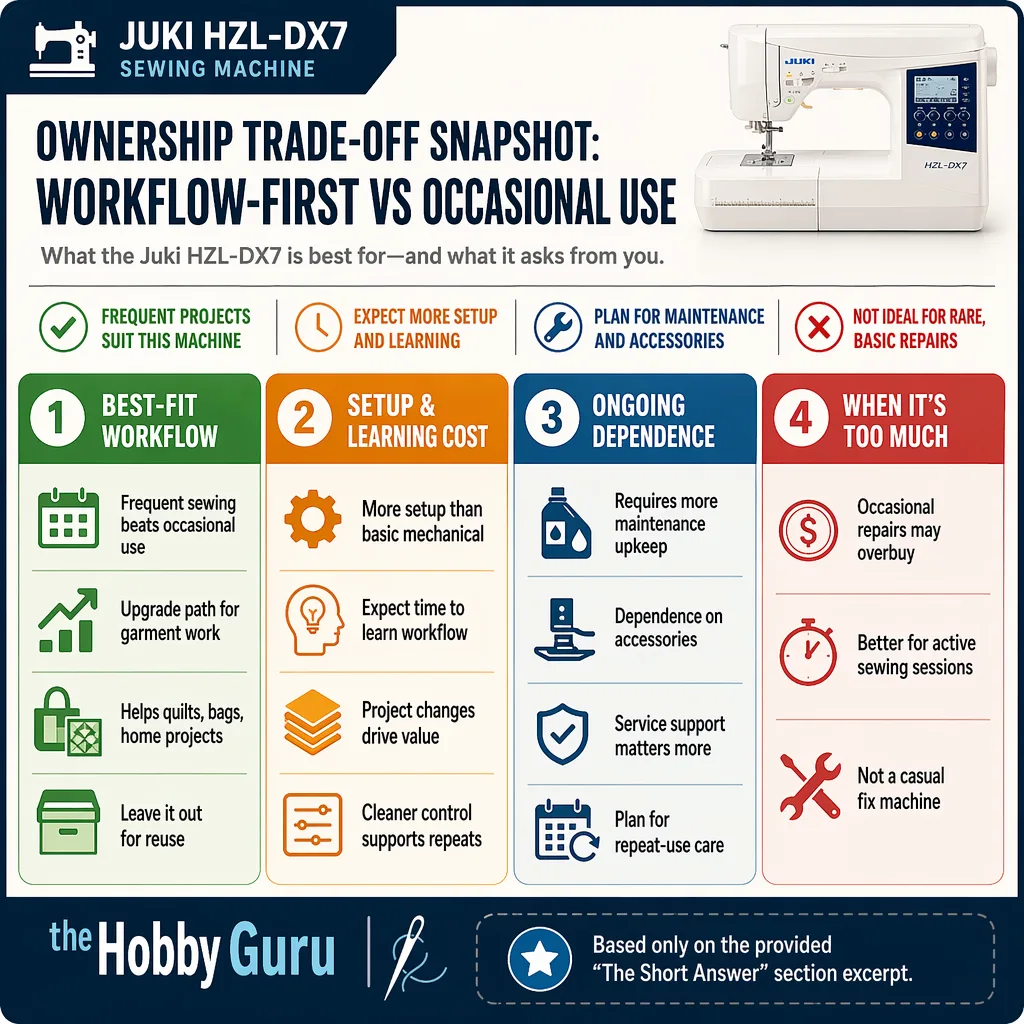
Strengths
- Better fit for frequent sewing than a starter machine
- Strong upgrade path for garments, quilts, bags, and home projects
- Better reason to leave a machine out on the bench all week
Trade-offs
- More setup and learning than a basic mechanical machine
- More dependence on maintenance, accessories, and service support
- Too much machine for occasional repairs
What This Analysis Is Based On
This is a buyer-fit read built around the HZL-DX7’s place in Juki’s premium home-sewing lane and the decisions that follow from that position. The questions that matter are not stitch count first, but setup effort, support, and accessory friction. That is the difference between a machine that feels like a tool and a machine that feels like a project.
Where the seller page leaves out accessory detail, treat that as a buying risk and ask before checkout. A premium machine without a clear parts path turns minor issues into stalled projects. A complete package with obvious support keeps the upgrade from becoming a maintenance headache.
Where It Makes Sense
The DX7 earns its keep when the machine stays ready on the bench and the work is regular. It is a poor match for a closet machine that comes out once a month.
Best-fit scenario A sewer who makes garments, quilts, bags, or mixed home projects often enough to appreciate clean control and a steadier setup routine.
Not the right fit A casual mender who wants the least possible maintenance and the quickest route from storage to stitch.
| Project type | Fit | Why it fits or falls short |
|---|---|---|
| Garments | Strong | Repeatable seam control matters more than raw feature volume on everyday apparel work. |
| Quilts and piecing | Strong | Long, accurate seams reward a machine that stays stable and easy to dial in. |
| Bags and layered utility projects | Strong | Better control matters when seams stack up and the work needs neat topstitching. |
| Occasional hemming and repairs | Weak | The DX7 brings more setup than the task deserves. |
| Shared family machine | Mixed | The machine works, but the learning curve and setup discipline add friction. |
The ownership trade-off is simple. The more often this machine sits ready, the more value it returns. The more often it gets packed away, the more you notice the time spent threading, cleaning, and resetting. That is why this model fits a dedicated sewing bench better than a general-purpose shelf.
Most guides chase decorative stitch variety as the main reason to upgrade. That is the wrong lens. A cleaner workflow, easier maintenance, and a machine that stays pleasant to reset between projects matter more than a long feature list.
Where the Claims Need Context
The biggest caveat is not stitch quality, it is ownership friction. A premium computerized machine asks for cleaner thread discipline, routine cleaning, and a plan for parts and service. Buyers who want a low-thought appliance feel that overhead quickly.
Deal-breaker callouts
- Skip it if local service support is thin. A premium machine without a service path turns minor issues into stalled projects.
- Skip it if you want universal accessory convenience. Verify feet, bobbins, needles, and any specialty pieces before purchase, especially on used listings.
- Skip it if the machine will live in a drawer or closet. The DX7 earns value through regular use, not storage.
- Skip it if your main task is occasional mending. The setup overhead and support needs outmatch that workload.
Used-machine shoppers need extra scrutiny. A missing accessory bundle changes the economics fast, and a seller who cannot show the included feet and power gear leaves too much guesswork. Ask for a complete parts count before the deal closes.
The maintenance point matters here. More control brings more responsibility, not less. A buyer who wants the easiest possible ownership experience should look at a simpler machine instead of forcing a premium model to act like a casual backup.
How It Compares With Alternatives
The closest comparison is not another flashy machine. It is a simpler mechanical or entry-level computerized model.
| Alternative | Better fit than the DX7 for | Where the DX7 wins |
|---|---|---|
| Basic mechanical machine | Absolute simplicity, low-frequency mending, minimal setup | Cleaner control, more serious project work, stronger upgrade logic |
| Entry-level computerized machine | Light-duty sewing, gentler learning curve, less accessory pressure | Better fit for a primary bench machine that gets used often |
A basic mechanical machine wins on low friction. It asks less from the user, needs less explanation, and fits a person who sews in short bursts. The DX7 wins when the buyer wants a primary machine that stays on the bench and handles more ambitious projects without feeling flimsy or cramped.
The entry-level computerized route sits in the middle. It suits buyers who want convenience with less commitment. The HZL-DX7 only pulls ahead when the extra refinement gets used often enough to justify the added setup and ownership attention.
The Next Step After Narrowing Juki Hzl-Dx7 Sewing Machine
The model name is only half the decision. The next step is judging the seller’s package, the service path, and the parts list that comes with it.
Treat the package as part of the machine
A bare-bones listing strips away value. The DX7 makes more sense when the accessory bundle is complete and the seller shows exactly what comes with it. That matters more on a used machine, where missing pieces turn a polished listing into a parts chase.
Plan the service path before checkout
A premium machine belongs with a realistic maintenance plan. Local dealer support, a dependable repair shop, or a seller who documents setup clearly keeps the machine moving instead of sitting idle. Buyers who ignore that piece end up judging the machine by avoidable friction rather than by the work it handles well.
Decision Checklist
Use the HZL-DX7 if all of these are true:
- The machine stays on a real sewing bench, not in long-term storage.
- You sew often enough to care about control and repeatability.
- You accept routine cleaning and accessory management.
- You have a service plan or a seller with a complete package.
Skip it if any of these are true:
- You want the simplest machine possible.
- Your projects are occasional repairs and hems.
- The accessory bundle is incomplete.
- Service access is poor.
Bottom Line
The Juki HZL-DX7 is worth the upgrade for a serious home sewer who wants one dependable machine for regular work and accepts the maintenance and support side of ownership. It is not the right buy for casual repairs, ultra-simple use, or anyone who wants the lowest-friction machine in the room. Choose it for workflow, not for novelty.
FAQ
Is the Juki HZL-DX7 good for quilting?
Yes. It fits quilting buyers who value controlled stitching, repeatable seams, and a machine that stays ready on the bench. It loses appeal if quilting is rare and the machine spends most of its time stored.
Is the HZL-DX7 too advanced for a beginner?
No, but it is more machine than a casual beginner needs. A beginner who plans to sew regularly and wants a long-term primary machine gets more value than a beginner who only wants a basic stitcher.
What should I verify before buying a used one?
Verify the full accessory kit, power gear, needle area condition, and whether the seller can show clean stitching across a few basic settings. Missing parts shrink the value fast.
How does it compare with a simpler mechanical machine?
A simpler mechanical machine wins on ease and low-maintenance convenience. The DX7 wins on control, repeatable results, and a stronger fit for regular sewing projects.
What is the biggest reason to skip it?
Skip it when you want the lowest maintenance and least setup. The DX7 pays off through regular use, and that value disappears when the machine sits unused between small jobs.
See Also
If you are weighing this model, also compare it with Brother LS14S Sewing Machine Review: Key Things to Know Before You Buy, What to Look for in Premium Craft Supplies for Your Workbench, and Wolfcraft Master 200 Review.
For broader context before you decide, Merino Wool vs Alpaca Wool: Which Is Best for Workwear? and Janome Memory Craft 400E Review: A Focused Embroidery Machine for Home Use help round out the trade-offs.