What Matters Most Up Front
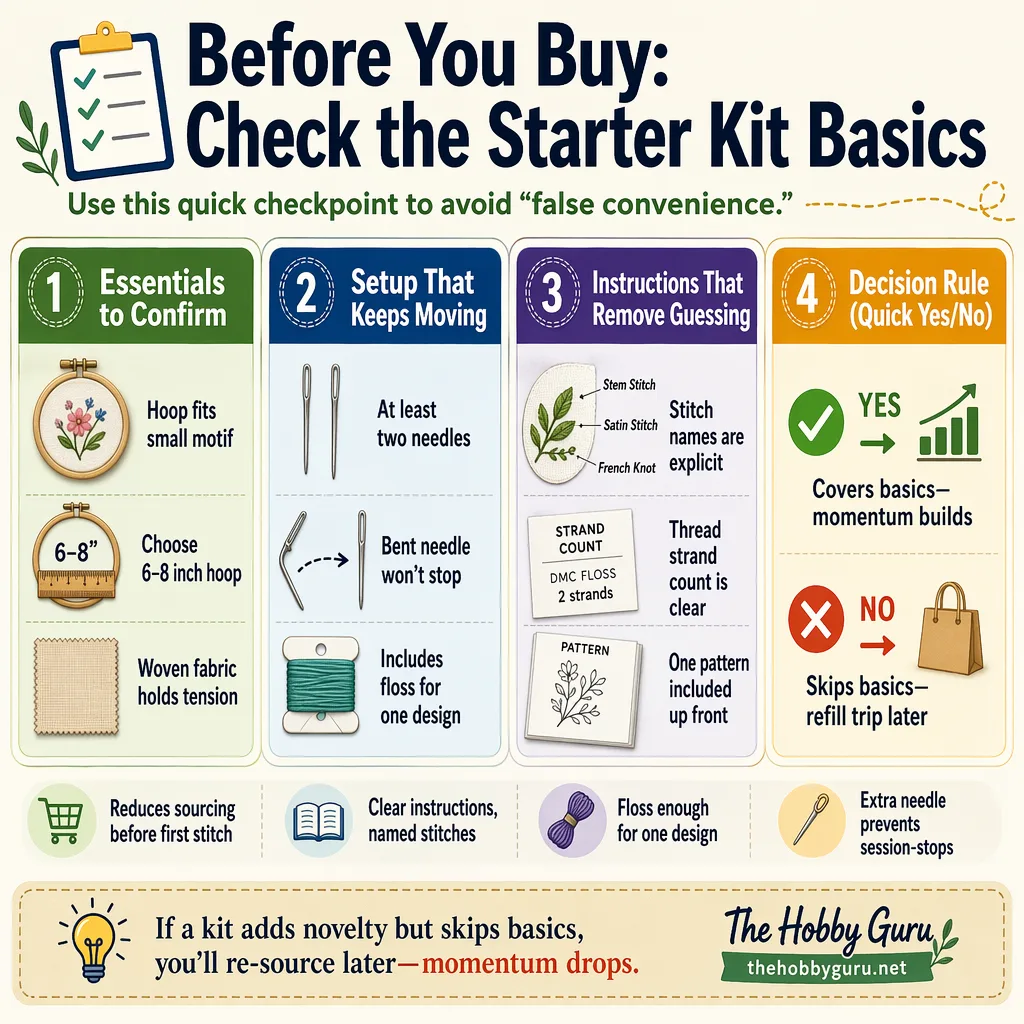
- A hoop large enough for a small motif, usually 6 to 8 inches
- Woven fabric with enough body to hold tension
- At least two needles, since one bent or misplaced needle stops the session
- Clear instructions that name stitches and thread strand count
- Enough floss to finish one design without a refill trip
A kit that covers those points builds momentum. A kit that skips them creates false convenience, because the missing pieces show up after the package is opened.
How to Compare Your Options
Compare kit shapes by setup burden, repeat-use value, and storage burden, not by how full the box looks. A beginner kit lives or dies by how quickly it gets from unopened to usable, and by how cleanly it resets for the next session.
| Kit shape | Setup burden | Repeat-use value | Storage burden | Best fit | Main trade-off |
|---|---|---|---|---|---|
| Minimal starter bundle | Low, if you already own a few basics | Strong for learning one stitch set | Low | Buyers who already own scissors, a hoop, or needle storage | Extra sourcing for missing tools or finish supplies |
| Complete beginner kit | Lowest, because most parts arrive together | Strong for a first finished piece | Moderate | People starting from zero | More packaging and more duplicate tools |
| Gift-style starter set | Low at first, but presentation adds layers | Weak unless the contents are clearly listed | Highest if the extras stay unused | Gift purchases where presentation matters | Budget goes into box design instead of useful supplies |
The middle row is the default for most first-time buyers. The minimal row wins when a workbench drawer already holds scissors, a hoop, and needles. The gift-style row looks polished, but polish does not finish a sampler.
What You Give Up Either Way
Choose simplicity and you give up convenience inside the box. Choose a fuller kit and you give up some control over what gets bundled in. That is the core trade-off, and it decides whether the purchase feels tidy or padded.
A larger set reduces the chance of missing a basic tool, but it also creates a sorting job. Extra floss colors sound generous until you have to wind, label, and store them. Extra accessories sound useful until you realize you already own three of them and now have one more pouch taking up space.
The wrong comparison is “more pieces equals better value.” That is false for beginners. One clean project with clear instructions matters more than a crowded kit that looks generous but slows the first session.
The Use-Case Map
Match the kit to the next project, not to the idea of embroidery in general. A beginner who wants one finished hoop piece needs different contents than someone who wants to make repeat gifts or decorative panels.
Best-fit scenario box
- First project from zero, pick a complete beginner kit with a clear pattern and all core tools
- Already own hoop, needles, and scissors, pick a slimmer bundle that only fills the gaps
- Buying for a gift, choose legible instructions and a neat presentation, not a giant accessory count
- Wanting mending or garment work, skip decorative starter kits and use a repair-focused supply list
A printed pattern helps the first finished piece happen faster, but it also locks the design in place. That works for a sampler or wall hoop. It works poorly for someone who wants to redesign a motif, shift placement, or repeat the project on different fabric later.
Where Embroidery Starter Kit For Beginner Is Worth Paying For
Pay for anything that removes repeat friction. Fabric that holds tension, a hoop that tightens smoothly, and instructions that explain stitch order all save time every session. That matters more than a box full of extras, because beginner frustration comes from setup confusion, not from a lack of novelty tools.
The best spending targets are practical:
- Better fabric that stays flat under tension
- A hoop that grips without fighting the screw
- Instructions that show the stitch path clearly
- Enough floss to finish the full pattern
- A simple storage method for needles and thread
Do not pay extra for decorative packaging unless the kit is a gift. Do not pay extra for a long list of tiny add-ons if the core supplies feel flimsy. A polished box with thin fabric and unclear directions gives a worse first experience than a plain kit with solid basics.
Maintenance and Upkeep Considerations
Choose a kit that stays organized after the first session, because restart friction matters more than people expect. Loose floss, scattered needles, and a crumpled pattern turn a 20-minute project into a cleanup job before any stitching starts.
The upkeep basics are simple:
- Keep floss separated by color or number
- Store needles in one place, not in the fabric fold
- Loosen the hoop after stitching so the fabric does not stay compressed
- Keep paper instructions flat or sleeved
- Replace frayed thread and bent needles early
This is where the hidden cost lives. A starter kit that looks complete but leaves you to manage tangled thread and vague labeling adds a maintenance burden that never appears on the front of the package. The kit that organizes cleanly keeps the project alive between sessions.
What to Verify Before Buying
Check the contents list, not the staged photo. Pictures show neat layouts. The list shows what arrives, what size it is, and what you still need to buy.
Verify these details before ordering:
- Hoop diameter
- Fabric type and finished pattern size
- Whether the kit includes needles and extras
- Whether the instructions name stitch count and thread strand count
- Whether the design is printed, iron-on, or transferred separately
- Whether the listing matches your Country/region selector
- Whether the language and shipping details match the version you expect
Ignore storefront clutter such as “Your cart is empty,” “Your cart,” and “Subtotal:” when you are judging the kit itself. Ignore banners like “Buy 3 kits or more and get 25% OFF” and “MOTHER’S DAY SALE UP TO 40% OFF” as well. Those lines describe the sale page, not the quality of the floss, hoop, or pattern.
A page can look busy and still sell a weak starter bundle. A page can look plain and still list the exact contents a beginner needs.
Who Should Skip This
Skip a full starter kit if the drawer already holds the basics. A second hoop, duplicate scissors, and more needles add clutter without improving the first stitch. In that case, a pattern and refill supplies make more sense than another full bundle.
Skip decorative kits if the goal is frequent use. Presentation-heavy sets look finished on arrival, but they often put money into packaging instead of reusable tools. Skip them again if you want garment embroidery or mending, since decorative sampler layouts waste time on a format that does not fit repair work.
Skip any bundle that hides measurements or leaves the instruction quality vague. Beginner kits succeed by removing decisions, not by creating a scavenger hunt.
Quick Checklist
Use this before buying:
- One clear project, not a pile of loose extras
- Hoop size in the 6- to 8-inch range
- Woven fabric with enough structure for tension
- Needles included, plus at least one spare
- Clear stitch instructions and thread strand guidance
- Enough floss to finish the design
- A simple storage plan for floss and needles
- No accessory filler that outranks the core materials
If two kits look similar, pick the one that lowers setup time and cleanup time. That choice pays off every time the project comes back to the table.
Common Misreads
More colors do not make a better beginner kit. They make more sorting work. A first project finishes faster with a controlled palette than with a giant thread rainbow that never gets used.
Pre-printed fabric is not automatically better. It removes transfer work, but it also fixes the design in place and limits later adjustments. Blank fabric asks more of the buyer up front, but it fits more design choices.
A fancy box does not equal a strong kit. Sale copy does not equal quality either. “Your cart is empty,” “Subtotal:,” and holiday banners do not tell you whether the fabric holds tension or the instructions actually teach the stitches.
Most guides recommend the largest bundle. That advice is wrong because beginners finish one project at a time, not twenty. Unused floss and duplicate tools become storage work, not progress.
The Practical Answer
Pick a complete starter kit when the goal is one clean first project and the table starts empty. Pick a slimmer bundle when the basic tools already live in a drawer. Skip decorative, oversized sets when repeat-use convenience matters more than presentation.
The best fit is simple: enough materials to finish one design, enough instruction to avoid guessing, and enough organization to make the next session easy. Everything else belongs in the second purchase, not the first.
Frequently Asked Questions
What should a beginner embroidery starter kit include?
It should include a hoop, woven fabric, floss, needles, a clear pattern, and instructions that explain stitch order. A spare needle matters because one bent or lost needle stops the project. A storage plan for the thread matters too, because loose floss becomes the fastest source of frustration.
Is pre-printed fabric better than blank fabric?
Pre-printed fabric is easier for a first hoop project because it removes transfer work. Blank fabric gives more flexibility and works better for repeated designs or custom placement. The better choice depends on whether the goal is a quick finish or more control.
How many floss colors are enough for a first project?
Enough to complete one design is the right number. A small starter piece usually works better with a tight color set than with a large rainbow of thread. Extra colors look generous, but they create more winding, labeling, and storage.
Do I need special scissors or threaders in the kit?
A sharp pair of small scissors or snips belongs with the kit, because clean cuts keep thread ends manageable. A threader helps if the needles are fine. A bundle without either item still works, but it raises the number of extras you need to supply yourself.
Is a gift-style kit a good buy for a first project?
It works only if the contents list is clear and the core materials are solid. Pretty packaging does not replace fabric quality, instruction clarity, or enough floss to finish the design. For learning, function outranks presentation.
What if I already own some embroidery supplies?
A slimmer kit fits better. If you already have a hoop, needles, scissors, or storage, a full starter bundle creates duplicates fast. Buy only the missing pieces and keep the first project simple.
See Also
If you want to move from general advice into actual product choices, start with Best Interchangeable Knitting Needles for Beginners: A Practical Buying Guide, What to Check When Buying a Magnifying Lamp for Crafts, and Best Hobby Vise Buying Guide: How to Choose the Right One.
For a wider picture after the basics, Best Heat Presses for T-Shirts: Three Current Buyer Paths and Janome Memory Craft 400E Review: A Focused Embroidery Machine for Home Use are the next places to read.