What Matters Most Up Front
Start with the shape of the fabric, not the size of the bundle. A scarf, a hat, and a sweater body demand different needle lengths, different cord behavior, and different amounts of setup room.
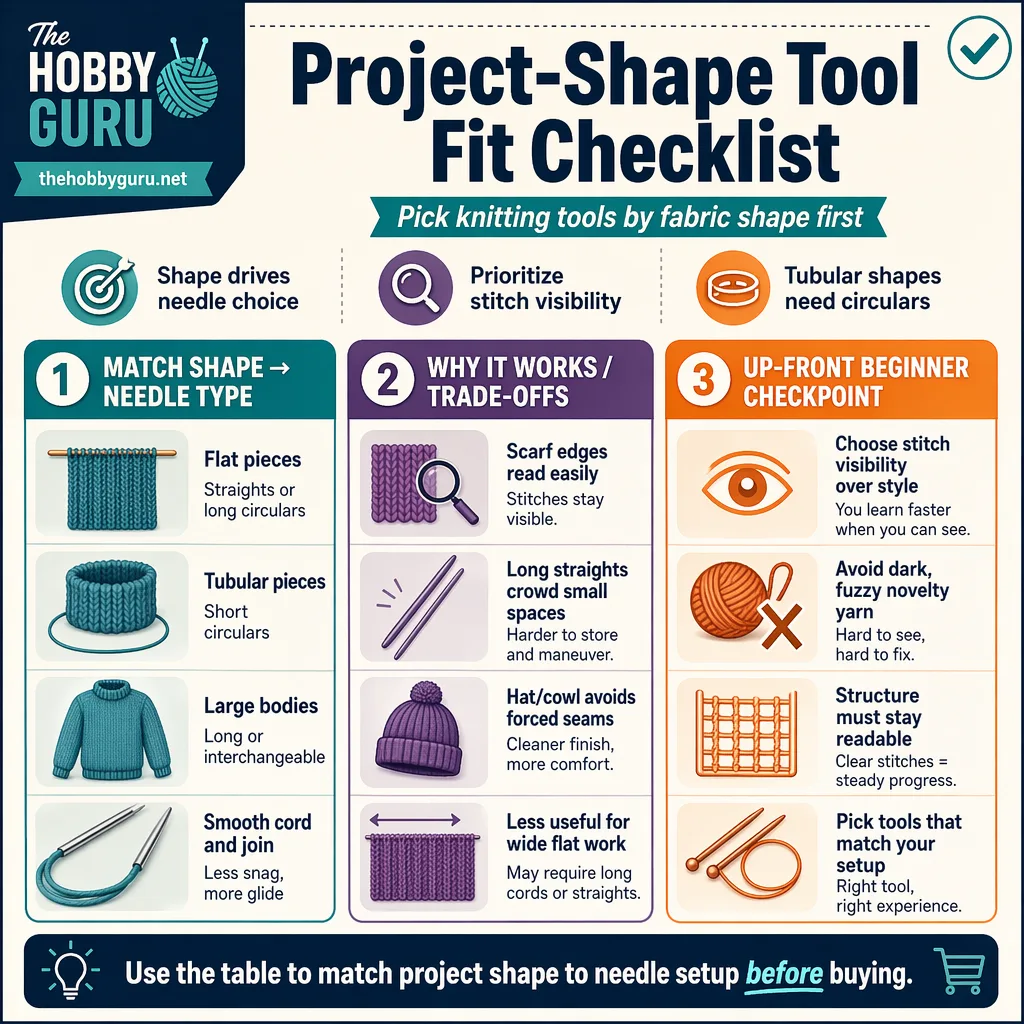
| Project shape | Best tool fit | Why it works | Trade-off |
|---|---|---|---|
| Scarf, washcloth, flat panel | Straight needles or long circulars | Simple edges and easy stitch reading | Long straights crowd small spaces and larger stitch counts |
| Hat, cowl, sleeves | Short circulars | Handles a small tube without forcing seams | Less useful for wide flat pieces |
| Sweater body, blanket | Long circulars or interchangeable needles | Supports many stitches and reduces seam work | More cord management and more setup time |
| Travel or couch knitting | Compact circulars and a small notions pouch | Keeps live stitches contained and the bench tidy | Fewer options for oversized or complex projects |
Most beginner guides push straight needles because they look simple. That advice fails on anything tubular, because the project shape forces you into a corded format sooner than you expect. A circular setup solves that problem without adding much complexity, as long as the cord and join stay smooth.
The first purchase should also favor stitch visibility over style. Dark, fuzzy, or novelty yarn hides the structure you need to read, and that slows every correction.
The Comparison Points That Actually Matter
Compare needle material, cord behavior, and join quality before you compare bundles. Those details decide whether the work feels controlled or fussy after the first hour.
- Bamboo and wood give grip. They slow slippery yarn and help tighter hands hold tension, but they drag more on fast stockinette.
- Metal gives speed. It slides cleanly and shows wear less, but loose tension turns into dropped stitches faster.
- Plastic stays light and often costs less, but flex and surface feel become the weak point on longer sessions.
- Sharper tips help decreases, lace, and cable crosses. Blunter tips reduce accidental splits, but they slow precise stitch pickup.
- Interchangeables save space and reduce duplicate purchases. The trade-off is connector management, and a rough join slows every row.
- Fixed needles remove assembly steps. The trade-off is less flexibility when project sizes change.
A smooth join matters more than a flashy finish. If yarn catches at the transition, the tool spends its energy arguing with the stitch instead of moving it.
The Compromise to Understand
Knitting rewards control, crochet rewards speed of build. That is the decision tension behind most first purchases.
Knitting vs crochet decision box
- Choose knitting if you want stretch, drape, and clear stitch columns.
- Choose crochet if you want faster growth, firmer fabric, and easier single-stitch repair.
- Choose knitting for garments, socks, and fabrics that need elasticity.
- Choose crochet for sturdy home items, quick gifts, and thick texture.
Knitting keeps many live stitches open at once, so gauge and tension matter from the start. Crochet holds one active loop, which makes mistakes easier to isolate. That difference explains why knitting asks for more patience up front and more payoff in fabric behavior later.
Most guides present knitting as the friendlier default craft. That is wrong because friendliness depends on the target fabric, not the label on the tool. If the finished piece needs stretch and smooth stitch definition, knitting wins the brief.
Common Buyer Scenarios
Match the first project to patience, not ambition. A first sweater looks impressive and teaches slowly, because the fabric volume creates more room for tension drift and sizing mistakes.
Best-fit scenario box A beginner who wants readable stitches and low stress should start with a garter scarf, dishcloth, or simple hat, not a full garment.
| If you want… | Start with… | Why it fits | What to skip |
|---|---|---|---|
| Very visible progress | Dishcloth or garter scarf | Repeated stitches make the fabric easy to read | Dark, fuzzy yarn |
| A fast finish | Cowl or chunky hat | Small circumference finishes sooner | Oversized blankets |
| Practice shaping | Simple hat | Decreases teach control without a full garment | Lace or colorwork |
| Low finishing work | Washcloths or coasters | Little to no seaming | Patterns with heavy assembly |
A small project teaches the bench rhythm faster than a grand one. That matters because the goal of the first buy is not to own more tools, it is to finish something cleanly enough that the next project feels obvious.
What to Check First
Etymology of the words knit and knitting
Knit traces back to an older Germanic idea of binding or tying. The word fits the craft because the fabric comes from linked loops, not woven crossings. Knitting keeps that same sense of joined structure in everyday language.
History and culture
Knitting moved through household labor, trade work, wartime production, and gift culture. That history explains why the craft values portability, repetition, and repair. It also explains why a practical knitting bench often looks organized but not crowded, with tools stored close and used often.
Differences and similarities between knitting and crocheting
Both crafts use yarn, hand tension, and pattern reading. Knitting holds more live stitches at once, which creates smoother fabric and stronger stretch. Crochet holds a single active loop, which creates firmer fabric and simpler stitch recovery.
Structure
Knitted fabric is looped structure, not woven cloth. That structure gives stretch across the row and lets shaping happen with increases and decreases. A first purchase should favor yarn that shows that structure clearly, because fuzzy yarn hides the fabric logic you are trying to learn.
Courses and wales
Courses run across the fabric, wales run up and down. Smooth, light-colored yarn makes both easier to read, and that speeds counting, fixing, and pattern tracking. This detail matters more than packaging because stitch visibility determines how fast the craft feels understandable.
The Next Step After Narrowing Knitting Workbench.
Buy in sequence, not all at once. Lock the first pattern, then choose the needle size, then buy the yarn, then add only the notions the pattern uses.
A narrow setup keeps the bench usable. One project bag, one measuring tape, one set of markers, and one yarn band with notes solve more problems than a drawer full of loose extras. The trade-off is less variety on day one, but the payoff is less clutter and fewer mismatched tools.
This is the point where many buyers overbuy. A full starter bundle looks efficient and leaves too many pieces unused. A focused setup keeps the first three sessions clean and repeatable.
Upkeep to Plan For
Plan on basic care from the start. A clean, organized knitting setup saves time every time you return to it.
- Wipe metal needles before storing them.
- Keep wood and bamboo away from damp bags and heat vents.
- Store circular cords relaxed, not wrapped tight, so they do not hold a hard coil.
- Check joins before each session so yarn does not snag on a rough seam.
- Keep yarn labels with the project so fiber content, color, and dye lot stay attached to the work.
- Use one container per active project to stop live stitches from mixing with leftovers.
Maintenance is a quiet filter. If the setup takes too much effort to reset, it stops getting used. The best tools disappear into the routine instead of adding chores.
What to Verify Before Buying
Check the published details line by line before you commit. If the listing or package leaves out the exact size, cord length, or connector system, the missing detail hides the part that decides fit.
- Needle sizes in U.S. and metric
- Fixed or interchangeable construction
- Cord lengths
- Needle material and tip shape
- Connector or join system
- Included notions and case size
- Care instructions and replacement part availability
For interchangeable sets, confirm that tips, cables, and adapters stay within one system. Mixed systems create storage confusion fast and trap you when a replacement cord does not match the rest of the bench. If the size list does not include the gauge range you plan to use, skip it.
Who Should Skip This
Skip knitting as the first craft if the main goal is speed, dense fabric, or the fewest possible counting steps. Crochet fits that brief better. Skip a large starter bundle if the plan is one scarf or one gift, because the extra tools turn into clutter instead of progress.
Anyone who hates live stitches sitting open on the needle will also feel friction here. Knitting asks for more attention to row structure and tension than a quick decorative craft does. That trade-off is part of the method, not a flaw in the hobby.
Final Buying Checklist
Use this as the last pass before you spend money or time on a setup.
- The first project is chosen.
- The needle type matches the project shape.
- The needle length fits the circumference.
- The yarn weight matches the pattern range.
- The yarn color still shows stitch structure.
- A 4-inch swatch is part of the plan.
- The join or cord system is clear.
- Storage for the active project is ready.
- You know which extras are actually required.
If two or more answers are no, the purchase is too broad. Narrow it before you add more gear.
Common Mistakes to Avoid
-
Buying the biggest set first.
Fix: choose the first pattern, then buy the tools that match it. Unused sizes add clutter and do nothing for the project. -
Starting with dark or fuzzy yarn.
Fix: use smooth, light yarn that shows stitches clearly. Hidden structure slows every correction. -
Skipping gauge.
Fix: knit a 4-inch swatch and treat it like the finished item will be treated. Size errors show up early that way. -
Picking the wrong needle length.
Fix: use short circulars for hats and sleeves, longer circulars for larger stitch counts. Crowded stitches fight every row. -
Ignoring storage.
Fix: keep one project bag, one label system, and one notions pouch. A tidy bench keeps the work repeatable.
Most beginner kits promise convenience through quantity. That is the wrong metric. Convenience comes from having the right tool in the right place, not from owning every size at once.
The Practical Answer
New knitters should start narrow, with one project, one yarn weight, and one matching needle setup. The goal is readable stitches and a clean finish, not a fully stocked drawer.
Returning knitters should spend attention on cord quality, storage, and the needle system they will reuse. Those details shape repeat-use convenience more than package size does.
Anyone who wants speed over stretch should choose crochet instead. Knitting earns its space when the finished piece needs elasticity, stitch definition, and a little more structure.
Frequently Asked Questions
What size knitting needles should a beginner buy?
A medium-weight yarn with needles in the yarn label’s recommended range gives the cleanest start, and U.S. 6 to U.S. 8 sits in that beginner-friendly zone. That range keeps the stitches readable without forcing tiny motions or oversized tension.
Are circular needles better than straight needles?
Circular needles handle hats, sleeves, blankets, and large stitch counts better. Straight needles still work for small flat pieces like scarves or washcloths. Circulars add cord management, while straights crowd the hands on bigger projects.
What does gauge mean in knitting?
Gauge is the number of stitches and rows in a measured space. It controls finished size, which is why a 4-inch swatch belongs in the buying plan. Ignore gauge and the finished piece misses the size you expected.
Is knitting easier than crocheting?
Knitting is easier for fabric with stretch and clear stitch columns. Crochet is easier for quick growth and single-stitch repair. The easier craft depends on the finished fabric, not on the label.
What should the first knitting project be?
A scarf, washcloth, cowl, or simple hat works best. These projects teach tension and stitch reading without the sizing pressure of a full garment.
Should the first purchase be a full starter kit?
No. A full kit adds sizes and accessories that do not match the first project. A focused purchase keeps the bench clean and gets the work moving faster.
Why does yarn color matter so much?
Light, smooth yarn shows the structure of the stitches, including courses and wales. Dark or fuzzy yarn hides mistakes and slows learning. Visibility beats novelty for the first purchase.
Do interchangeable needles make sense for a beginner?
They make sense only if the first few projects already need different lengths or sizes. Fixed needles are simpler for one project. Interchangeables pay off when the setup gets reused across multiple jobs.
See Also
If you want to move from general advice into actual product choices, start with Sewing Workbench Setup Guide: What to Know Before You Buy a Table and Storage, Brother or Singer Sewing Machine Buying Guide, and What to Look for in Baby Knitting Yarn: Softness, Safety, and Care.
For a wider picture after the basics, Steam Iron vs Garment Steamer for Workbenches: Which One Is Better for Your Setup? and Janome Memory Craft 400E Review: A Focused Embroidery Machine for Home Use are the next places to read.