What To Prioritize First
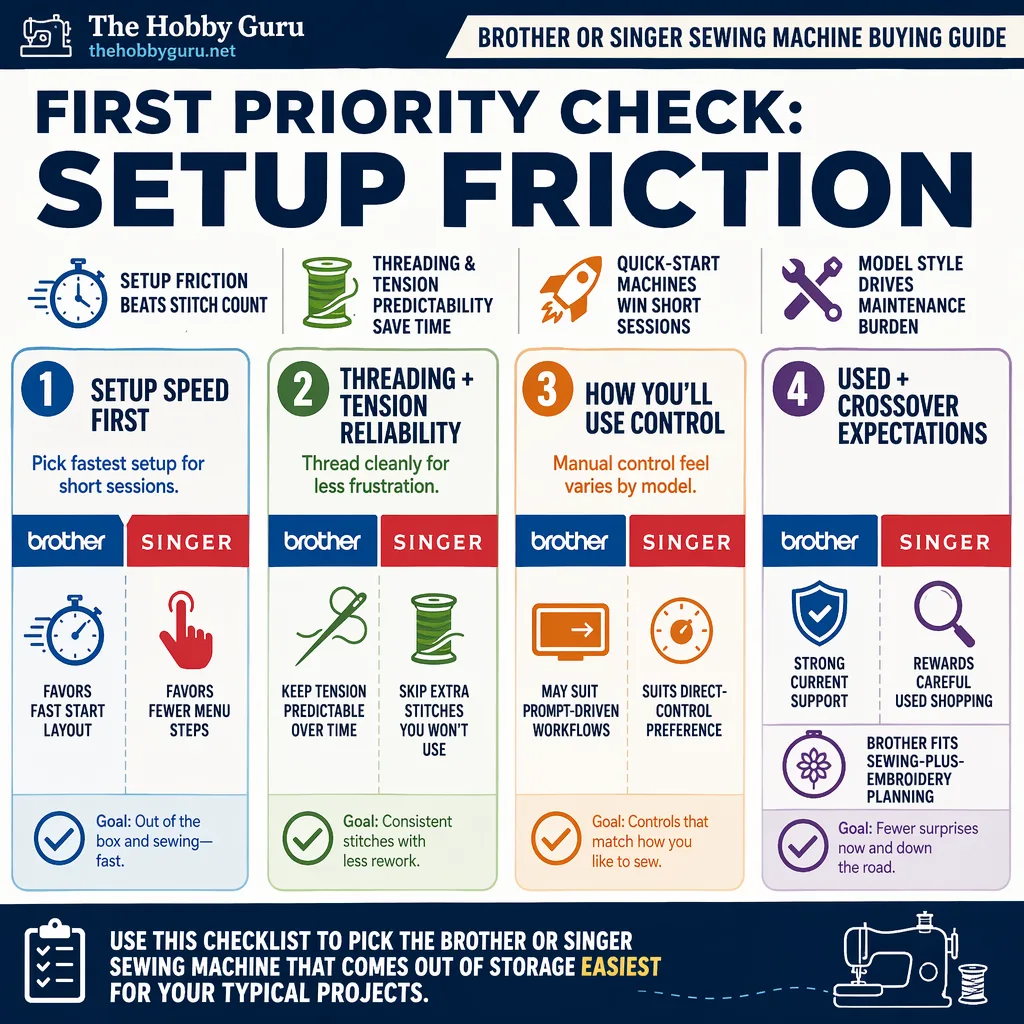
Most buyers chase decorative stitch menus first. That is the wrong order because a machine that threads cleanly, accepts the right bobbin system, and keeps tension predictable saves more time than twenty extra stitches you never use. For short hobby sessions, the machine that gets ready fastest wins.
Mini scorecard for Brother vs Singer
| Decision factor | Brother edge | Singer edge | What it means at the bench |
|---|---|---|---|
| Setup speed | Fast start, convenience-first layout | Simple manual path on basic models | Choose Brother for quick sessions, Singer for fewer menu steps |
| Manual control | Model-dependent | Strong on plain mechanical machines | Singer fits users who like direct control and fewer prompts |
| Secondhand repair culture | Good on current support | Deep on older mechanical machines | Singer rewards people who shop used and inspect carefully |
| Embroidery crossover | Clearer path | Less central to the brand story | Brother fits sewing-plus-embroidery planning better |
| Low-drama maintenance | Good if the model stays simple | Good if the machine stays mechanical | Maintenance burden depends more on model style than logo |
Best-fit scenario box
- Choose Brother if you sew in 20 to 60 minute bursts, want faster threading, and use mixed fabrics.
- Choose Singer if you want a plain mechanical machine, care about vintage familiarity, or plan to shop the used market.
- Choose neither if you need embroidery-only work, serging, or production-level straight stitching.
A plain mechanical machine stays the best baseline comparison. If your regular work is straight seams, zigzag, hems, and basic repairs, extra menus add little value unless they reduce setup time.
What To Compare
Compare the workflow, not the logo. A Singer vs Brother sewing machines review makes sense only if it measures what happens before and after the seam, not just the front-panel feature list.
Most guides recommend picking by stitch count. That is wrong because stitch count never fixes a poor threading path, awkward bobbin access, or a machine that takes too long to put back into service after storage. The useful differences sit in how the machine feeds fabric, how fast it gets ready, and how much you need to remember between sessions.
The comparison points that actually matter
- Threading path: Faster threading matters more than novelty stitches.
- Bobbin access: Easy bobbin changes shorten every project with stop-and-start sewing.
- Presser foot options: Zipper, buttonhole, and general utility feet matter more than decorative extras.
- Repair path: Used Singer machines often benefit from a broader mechanical repair conversation.
- Interface load: Brother leans toward convenience, Singer leans toward straightforward control on basic machines.
If your bench sees varied projects, Brother usually gives the cleaner workflow. If your bench sees one or two repeat tasks and you prefer fewer controls, Singer stays easier to live with.
The Trade-Off to Weigh
Convenience and simplicity pull in opposite directions. Brother shortens the path from storage to sewing, while Singer keeps the control scheme more direct on many mechanical-style machines.
That trade-off matters most on weeknight projects. If the machine gets used in short bursts, every extra minute spent re-threading or remembering settings feels expensive in time, not dollars. If the machine stays out on a dedicated table, the value shifts toward a simpler layout that does not demand menu navigation.
A hidden cost sits on both sides. More automation adds parts and features to keep clean and learn. Simpler machines ask more from the operator during setup and adjustment. The better machine is the one that matches the amount of attention the bench really gets.
The Context Check
Brand history matters because it shapes the kinds of machines shoppers expect to find and the kind of support culture that exists around them. It does not replace model-level checking.
Brief Singer Sewing Machine Company History
Singer built a long domestic-sewing reputation through mechanical machines that reached ordinary homes and workshop tables. That legacy still influences the used market and the repair conversation around older units. It also creates a common mistake, people treat the Singer name as if it means one build style, when it covers a wide spread of eras and designs.
Post WWII Singer
Postwar Singer machines became a reference point for sturdy household sewing and familiar service behavior. That legacy helps buyers who want a machine many repair shops recognize quickly. It does not guarantee a smart purchase, because missing feet, worn wiring, and incomplete accessories matter more than nostalgia.
Brief Brother Sewing & Embroidery History
Brother grew into home sewing with an emphasis on approachable machines and later expanded hard into sewing and embroidery automation. That history still shows up in the brand’s convenience-first reputation. The trade-off is a little more interface, a little more setup, and a little more reason to keep the manual nearby.
2012 and beyond
From 2012 and beyond, both brands leaned harder into computerized home machines while still keeping mechanical entry points in the market. The logo stopped predicting the control style. The model era and feature set took over, which is why a current Singer and a current Brother need a side-by-side look instead of a brand-memory shortcut.
The Use-Case Map
Match the brand family to the job you do most often. That approach keeps you from overbuying features you never touch.
| Project type | Better fit | Why it wins | Trade-off |
|---|---|---|---|
| Quick hems and mending | Brother | Faster setup gets you sewing sooner | Extra features add a little learning overhead |
| Simple garments and craft sewing | Brother | Repeat starts and stops feel smoother | More parts to clean and remember |
| Repair-first bench use | Singer | Mechanical control and repair familiarity help | Older units demand closer inspection |
| Embroidery personalization | Brother | Brother has the clearer sewing-plus-embroidery path | The interface takes time to learn |
| Straight-stitch only work | Singer or a plain mechanical machine | Minimal controls suit one-job use | Decorative flexibility drops off fast |
If your work is mostly cuffs, curtain hems, tote bags, patches, and small garment fixes, the best machine is the one that sits ready without a long warmup. For thicker stacks, the better choice comes down to presser-foot lift, feed behavior, and whether the machine handles your fabric without constant coaxing.
Maintenance and Upkeep Considerations
Choose the machine you will clean and thread without dreading it. Maintenance burden is the strongest proof point in this comparison because it shapes whether the machine stays on the table or gets shoved back in the closet.
Brother rewards a setup where cords, manual, needles, and bobbins stay organized together. Singer rewards users who accept a simpler mechanical routine and keep a closer eye on condition, especially on older units. Either brand suffers when lint builds up around the bobbin area and feed dogs.
A useful habit matters more than model lore: test on scrap after storage, after thread changes, and after switching fabric families. A machine that sits for months loses more time to re-threading and re-adjustment than one that runs every week. That reality matters for hobby rooms, sewing cabinets, and shared family spaces where the machine gets moved around.
Keep these checks on repeat
- Clean lint from the bobbin and feed area after dense or fuzzy sewing.
- Match needles to the fabric instead of forcing one needle through every project.
- Keep the manual with the pedal and accessory pack.
- Verify the tension on scrap before touching visible seams.
- Store the machine where it stays flat and easy to reach.
Constraints You Should Check
Check the manual, the accessory list, and the service path before you pay. Those details expose the real limits of a sewing machine better than a brand badge does.
Look for the bobbin system, threading path, included feet, stitch range, and whether a manual is easy to find. If the listing hides the manual or glosses over accessories, treat that as a real cost, not a minor omission. A machine with clear documentation and the right feet beats a feature-rich machine with no support trail.
Check these published details
- Top-drop or front-load bobbin system
- Automatic needle threader, if included
- Included feet for zipper, buttonhole, and utility stitching
- Free-arm access for cuffs and sleeves
- Manual availability and parts diagram
- Local service familiarity, especially for used Singer machines
- Missing accessories on any secondhand listing
For used Singers, inspect power cords, foot controls, and the condition of the accessory set. For Brothers, check whether the convenience features still match the manual and whether all the small parts are present. Missing parts create the kind of delay that never shows up in a glossy listing.
The Next Step After Narrowing Brother Or Singer Sewing Machine
Set up the bench before you set up the machine. The next purchase is the workflow that keeps the machine easy to use every time you sit down.
A small accessory tray saves more time than another decorative stitch. Keep needles, bobbins, seam ripper, presser feet, thread snips, and the manual within arm’s reach. That habit matters on both brands, but it matters most on the machine that gets used in short bursts because setup friction disappears only when the tools stay organized.
Lighting matters too. A bright, stable workspace makes tension checks and needle changes faster, and that pays off on Brother and Singer alike. A machine that lives on a crowded table never feels as convenient as the brand marketing promises.
Who Should Skip This
Skip both brands if your real job is outside general home sewing. A Brother or Singer sewing machine is not the best match for every bench.
- Skip both if you need a dedicated serger for knit seam finishing.
- Skip both if you need embroidery as the main function, not a side feature.
- Skip both if your work demands industrial straight-stitch output or very thick, repetitive stacks.
- Skip a vintage Singer path if restoration itself is not part of the hobby.
- Skip a convenience-heavy Brother if you want a stripped-down mechanical experience and never use automatic helpers.
That last point matters. Buying a feature-rich machine and refusing to use the features adds clutter without giving back speed.
Quick Checklist
Use this list before you decide.
- You sew often enough that setup time matters.
- Your usual fabric stays within the machine’s documented limits.
- You know whether you want convenience features or a simpler manual layout.
- The manual is available before you buy.
- The bobbin system and included feet match the jobs you do.
- You have a clean storage spot or a dedicated table.
- You accept the maintenance style that comes with the brand family you choose.
If more than two of those boxes stay empty, the wrong machine is in view.
Common Mistakes to Avoid
Pick by workflow, not by nostalgia. That is the first mistake, and it drives most bad buys.
- Choosing by stitch count alone. More stitches do not fix threading friction, weak setup, or poor fabric handling.
- Assuming all Singers are mechanical. Singer covers both simple and more feature-heavy machines.
- Assuming all Brothers are complicated. Brother also sells straightforward home machines.
- Buying a used machine with missing accessories. Feet, bobbins, manuals, and pedals matter more than the front-panel photo.
- Ignoring maintenance access. A machine that is annoying to clean never becomes the one you reach for first.
The right question is not which brand sounds stronger. The right question is which brand gets you sewing faster, with less cleanup and less re-learning between projects.
The Bottom Line
Brother is the cleaner buy for hobby sewers who want fast setup, easier repeat use, and a stronger path into sewing-plus-embroidery convenience. Singer is the cleaner buy for shoppers who want a simpler mechanical feel, value the used-market repair ecosystem, and prefer a more direct control layout.
For weekly mending, garments, quilts, and mixed craft work, Brother fits the rhythm better. For straightforward repairs, vintage-minded shopping, and bench use that rewards manual control, Singer fits better. If the machine will stay on a dedicated table and get used often, convenience wins. If the machine will come out for a few focused jobs and you want simpler mechanics, Singer holds the edge.
Frequently Asked Questions
Is Brother better than Singer for beginners?
Brother is better for beginners who want less setup friction and clearer automatic helpers. Singer is better for beginners who want a simpler manual layout and do not want to learn as many convenience features on day one.
Which brand is better for quilting?
Brother fits quilters who value quick setup and repeat use on lighter quilting work. The deciding factor on larger quilts is throat space and workspace, which vary by model, so check those details before choosing by brand alone.
Are Singer machines better for heavy fabric?
Singer is not automatically better for heavy fabric. The specific machine, presser-foot lift, feed behavior, needle choice, and condition decide that job far more than the logo.
Should I buy a vintage Singer?
Buy a vintage Singer only if the machine is complete, runs smoothly, and the missing parts are documented. A cheap vintage machine with worn wiring, missing feet, or an absent manual turns into a restoration project fast.
Does Brother make embroidery easier?
Brother is the clearer starting point for sewing plus embroidery because the brand built a stronger convenience-first reputation in that lane. The trade-off is more setup, more options to learn, and more need to keep the accessories organized.
What matters more than brand name?
The specific model, the manual, the bobbin system, the threading path, and maintenance access matter more than the name on the front. A well-documented machine that fits your projects beats a famous logo with the wrong workflow.
See Also
If you want to move from general advice into actual product choices, start with Janome or Bernina Sewing Machine Buying Guide, Sewing Machine or Serger Buying Guide, and How to Choose a Hobby Vacuum.
For a wider picture after the basics, Best Steam Irons for Quilters in 2026 and Janome Memory Craft 400E Review: A Focused Embroidery Machine for Home Use are the next places to read.