The First Thing to Get Right
| Decision parameter | Sewing machine | Serger | Stronger fit |
|---|---|---|---|
| Main job | Seam construction, topstitching, buttonholes, zippers | Seam finishing, trimming, stretch seams | Sewing machine for general use |
| Raw edge control | Overcast stitch or zigzag covers the need | Trims and finishes in one pass | Serger for frequent finishing |
| Knit fabric workflow | Works, but slower at finishing | Built for stretch seams and clean edges | Serger for knit-heavy sewing |
| Setup burden | Lower threading and cleaning load | More threading steps and lint cleanup | Sewing machine for low-friction use |
| One-machine ownership | Covers the widest range of projects | Leaves gaps in construction tasks | Sewing machine first |
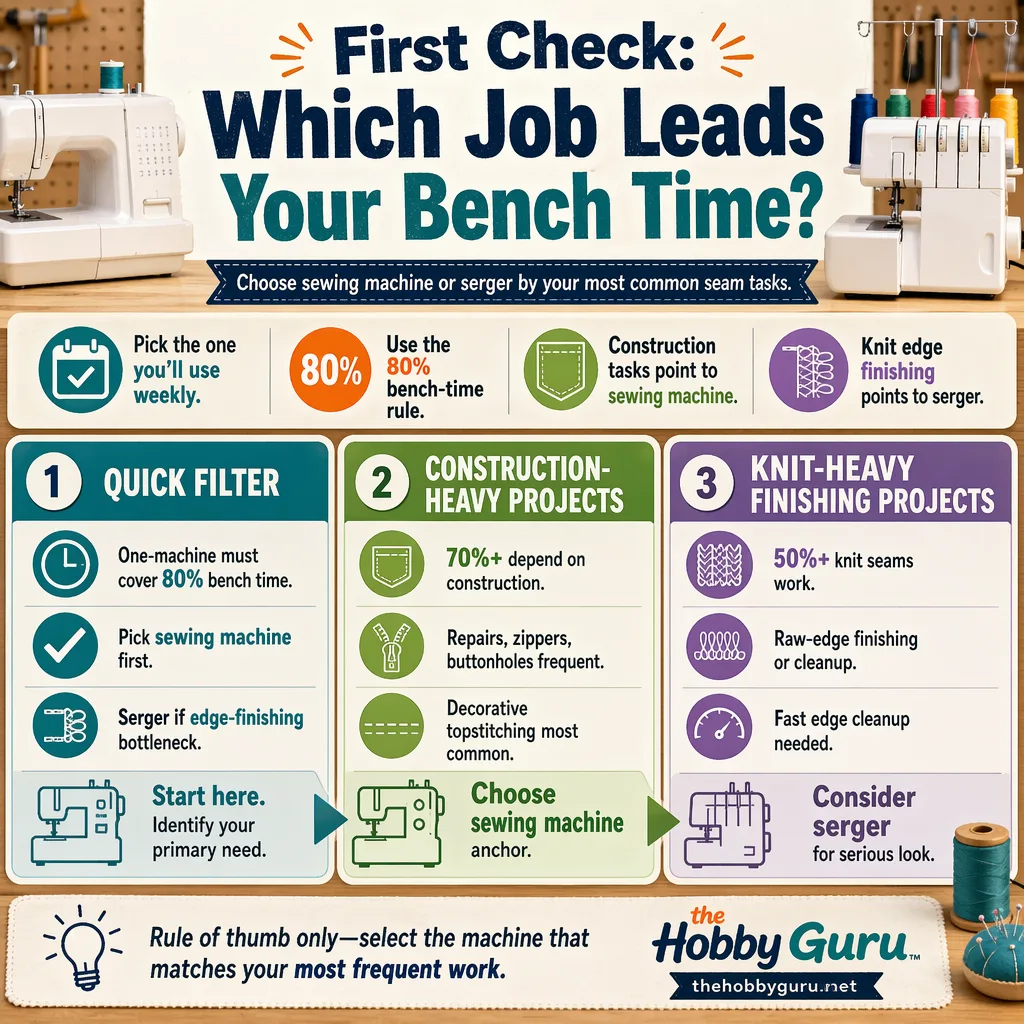
The simplest rule of thumb is direct: if one machine must cover 80 percent of your bench time, pick the sewing machine. If your seams already get built another way and the bottleneck sits at the edge finish, the serger moves up.
How to Weigh the Options
Compare what each machine does after the fabric is under the foot, not the number of stitches on the spec sheet. A sewing machine joins fabric and handles detailed construction. A serger trims the seam allowance and wraps the edge, which creates a clean inside finish and saves time on repetitive projects.
Most guides treat a serger as a universal upgrade. That is wrong. A serger does not replace straight stitching, buttonholes, zip installation, or most topstitching. It specializes in a narrower band of work, and that narrowness is the point.
Use this split:
- Choose a sewing machine if you sew quilts, bags, garments with zippers, hems, buttons, and repairs.
- Choose a serger if you sew knits, activewear, or garments that need fast, neat internal seams.
- Choose neither first if your only goal is occasional raw-edge cleanup. A zigzag stitch or overcast stitch on a sewing machine covers that need without adding another machine to maintain.
What You Give Up Either Way
A sewing machine gives flexibility, and a serger gives speed plus cleaner edges. The trade-off sits in the details the packaging rarely emphasizes. A serger uses more thread, trims fabric as it sews, and adds a knife and looper path that need regular cleaning. That means more consumables, more lint at the bench, and more time spent getting it ready after a long pause.
A sewing machine gives up the polished inside finish that a serger creates in one pass. A serger gives up the broad task range that makes a sewing machine the foundation tool. If you need one machine to stay ready for repairs, alterations, and odd jobs, the sewing machine wins because it covers the most seams with the least setup friction.
The hidden ownership cost shows up in the first few project sessions. A serger that sits untouched for weeks turns threading into the first task. A sewing machine returns to service faster, which matters when the hobby time window is short.
The Use-Case Map
Match the machine to the project stack, not to the idea of “better.” Different hobby lanes reward different tools.
- Quilting and patchwork: Sewing machine. Precision piecing matters more than edge trimming.
- Alterations and mending: Sewing machine. Zippers, hems, patching, and topstitching come first.
- Garments in woven fabric: Sewing machine first. Seam construction and fitting control matter more than speed finishing.
- Knit tops, leggings, activewear: Serger moves up fast. Stretch seams and edge cleanup define the workflow.
- Small-batch sewing of repeated items: Serger helps after the sewing machine does the main construction.
- Knits with only hem finishing: A coverstitch machine fits better than a serger if hems are the only pain point.
That last point matters. A coverstitch machine solves knit hems more directly than a serger alone. If the real problem is hems, not seam finishing, the narrower tool beats the default upgrade.
Maintenance and Upkeep Considerations
Buy the machine you will clean and rethread without resentment. The sewing machine asks for regular bobbin-area cleaning, needle changes, and occasional tension checks. The serger asks for all of that plus more threading paths, more lint buildup around the knives and loopers, and more attention to thread order.
A serger rewards frequent use. A machine that gets used every week keeps the threading path familiar and the setup time short. A machine that sits for months collects dust in the exact places that slow the first seam, which turns a quick task into a tuning session.
Keep this maintenance checklist in view:
- Can the looper area or bobbin area open easily?
- Does the manual show a clear threading route?
- Is the knife area simple to clean?
- Are replacement needles and threads easy to store at the bench?
- Does the machine stay tolerable after a week of no use?
What to Verify Before Buying
Check the published details that match your fabric stack and your space before you spend time on stitch counts. A machine that fits the catalog description but not the work surface becomes annoying fast. A 12-inch-deep shelf leaves little room for fabric control, and 18 inches of clear depth makes larger pieces easier to manage.
For a sewing machine, verify:
- Free arm access for cuffs and hems
- Buttonhole type
- Needle positions
- Twin-needle support
- Presser foot lift for thicker seams
For a serger, verify:
- Number of threads and stitch modes
- Differential feed
- Rolled hem setup
- Knife access
- Threading diagram in the manual
Secondhand sergers deserve extra scrutiny here. Cosmetic wear matters less than missing manuals, missing diagrams, or unclear threading paths. Those gaps slow every future project.
Proof Points to Check for Sewing Machine Or Serger
Look for proof that the machine fits your actual workflow, not just a glossy feature list. The clearest proof lives in the manual, the accessory list, and the documented stitch options.
Check these details first:
- A threading diagram that is visible and complete
- A manual that explains setup without vague diagrams
- Stitch and seam options that match your fabric types
- Needle and foot compatibility that matches your usual jobs
- Clear notes on servicing, cleaning, or parts access
- For sergers, documented differential feed and knife behavior
- For sewing machines, documented buttonhole, free arm, and topstitching support
A long stitch list does not prove usefulness. Clear setup instructions do. A machine that looks versatile on paper but fights you at thread change time sits unused more often than a simpler model that stays ready.
When Another Option Makes More Sense
Pick the narrower tool when the job is narrower. A serger makes no sense as the first buy for quilting, patchwork, embroidery, or decorative topstitching. A sewing machine covers those jobs with less setup and far more flexibility.
If your work is mostly knit hems, a coverstitch machine beats a serger for that one task. If you only need occasional edge finishing, an overcast stitch or zigzag stitch on a sewing machine handles it. If you sew bags or heavy seams, a sewing machine with the right needle, foot, and stitch choice stays the better core machine.
The wrong move is buying a serger because it sounds more professional. Professional does not matter if it leaves the rest of your bench work uncovered.
Before You Buy
Use this quick check before deciding:
- List your three most common project types.
- Count how often you sew knits versus woven fabric.
- Measure your work surface depth and side clearance.
- Decide whether thread reloading sounds routine or annoying.
- Check whether you need buttonholes, zippers, decorative stitches, or raw-edge finishing.
- Confirm that one machine covers at least 80 percent of your usual work.
If the answer stays mixed, the sewing machine stays first. If the answer leans hard toward knits and edge finishing, the serger moves up. If both feel necessary, the sewing machine still comes first because it supports the widest project range.
Common Mistakes to Avoid
Do not buy the serger first because it sounds like the advanced choice. Advanced is not useful if the machine skips basic construction tasks. Do not choose by stitch count alone either. Capability in hobby sewing starts with the stitches you use every week, not the ones you read about and never touch.
Other common wrong turns:
- Ignoring thread and cleaning costs
- Assuming a serger replaces a sewing machine
- Skipping space checks for fabric handling
- Buying without reading the threading diagram
- Forgetting that setup time affects how often the machine gets used
The cleanest buy is the one that stays easy enough to pull out on a weeknight.
The Practical Answer
Get a sewing machine first if your hobby includes construction, repairs, quilting, topstitching, or mixed fabric work. Add a serger when knit seams, raw-edge finishing, and repeat edge cleanup start to define the bench time. If storage space, threading patience, or upkeep tolerance stay limited, the sewing machine wins again.
A serger belongs on the bench after the sewing machine proves a real need for faster edge finishing. That sequence keeps the workflow sane and avoids a machine that solves one problem while leaving three others untouched.
Frequently Asked Questions
Do I need both a sewing machine and a serger?
No. A sewing machine covers the broader set of hobby tasks, and a serger only earns its spot when seam finishing and knit work become routine.
Can a sewing machine finish seams like a serger?
Yes, through overcast stitches or zigzag stitches, but not with the same speed or inside finish on stretch-heavy seams.
What projects justify a serger first?
Knit garments, activewear, and repetitive seam finishing justify a serger first if those jobs dominate the project list.
Is a serger hard to maintain?
It asks for more upkeep than a sewing machine. Threading paths, knives, and lint cleanup raise the routine burden.
Which one fits beginners better?
A sewing machine fits beginners better because it handles more project types and stays simpler to set up and clean.
Is a coverstitch machine a better choice than a serger?
Yes, if your main problem is knit hems rather than seam finishing. A coverstitch solves that narrower job more directly.
See Also
If you want to move from general advice into actual product choices, start with Brother or Singer Sewing Machine Buying Guide, Janome or Bernina Sewing Machine Buying Guide, and How to Choose a Sewing Light.
For a wider picture after the basics, Janome Horizon Memory Craft 15000 Sewing Machine Review and Janome Memory Craft 400E Review: A Focused Embroidery Machine for Home Use are the next places to read.