
Start With the Main Constraint
Buy this only for a project list that leans hard toward repeat output. The machine earns bench space when the work is repetitive, the shape is mostly round, and the finished piece does not need heavy shaping at every stage.
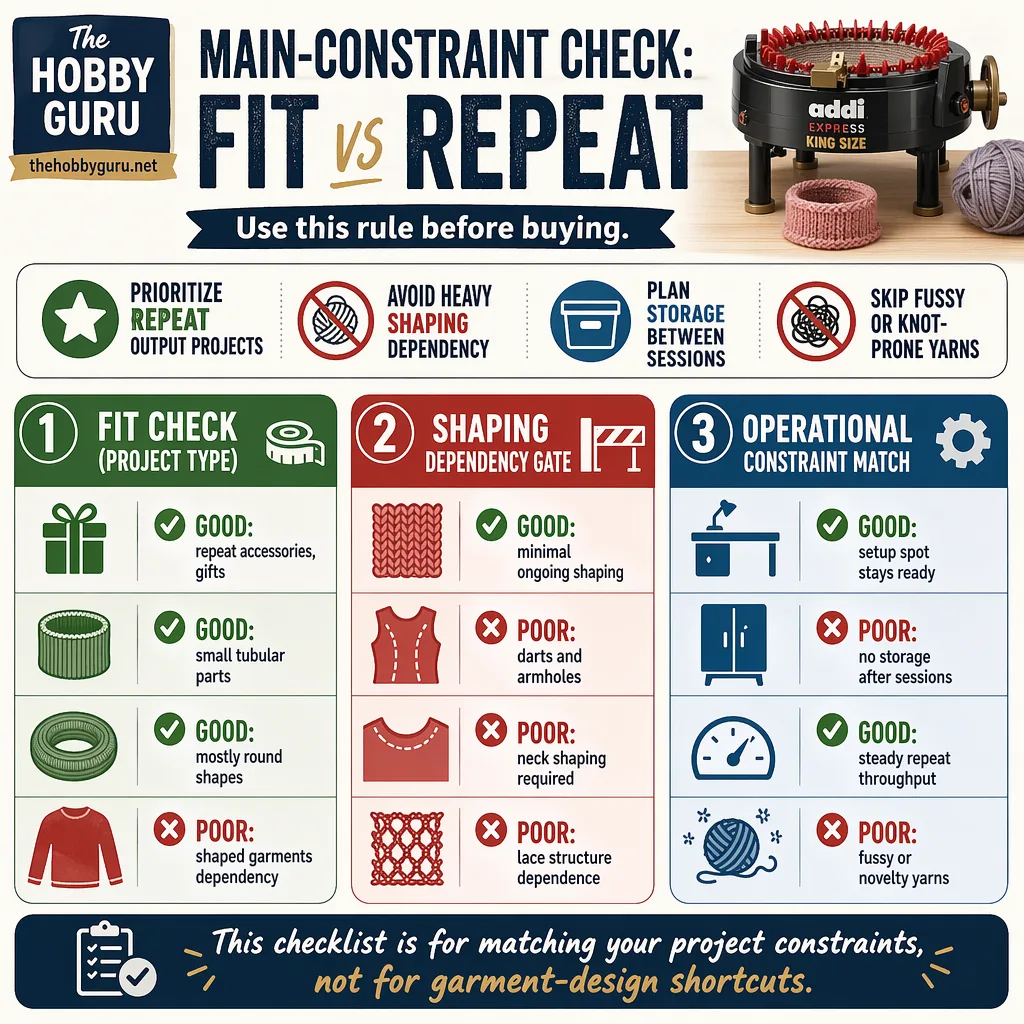
A simple rule works here:
- 80 percent accessories, gift batches, or small tubular parts, good fit.
- 50 percent or more shaped garments, poor fit.
- Storage after every session, only a fit if the setup spot stays ready.
- Fussy yarns, novelty yarns, or frequent knotting, poor fit.
Most guides sell a circular knitting machine as a sweater shortcut. That is wrong because the machine solves throughput, not garment design. The minute the project depends on darts, armhole shaping, neck shaping, or lace structure, hand knitting or a different machine format takes the lead.
How to Compare Your Options
Compare workflow first, not feature count. The useful question is whether you want a bench tool that compresses repetitive labor, or a general knitting method that handles every shape at the cost of speed.
| Decision parameter | King-size circular machine | Smaller circular machine | Hand knitting |
|---|---|---|---|
| Best project shape | Tubes, cuffs, hats, small panels | Smaller tubes, child-size items, compact output | Any shape |
| Bench demand | Stable surface and dedicated setup | Less footprint, still needs a solid base | Minimal tooling |
| Setup and cleanup | Moderate, yarn path and cleanup matter | Moderate, with less material movement | Low tooling, higher labor |
| Skill bottleneck | Yarn feeding, tension, and consistency | Tension and small circumference control | Stitch control and shaping |
| Main trade-off | Limited shaping freedom | Smaller output ceiling | Slowest production |
The table matters because the hidden cost is not the machine itself. It is the amount of time you spend setting up, cleaning out lint, and putting the tool away. A tool that stays out on the bench gets used. A tool that needs a full reset every time becomes a special-occasion item.
The Choice That Shapes the Rest
The core trade-off is speed against shaping freedom. If the work list lives inside the tube-and-repeat lane, the machine makes sense. If the work list asks for structure, stitch variety, or fitted fabric, the machine only solves part of the job.
That trade-off explains the biggest misconception. People buy circular machines expecting them to replace a full knitwear workflow. They do not, because the difficult part of garments is not simple fabric production, it is controlling shape, edge behavior, and finishing. The machine reduces hand labor, but it does not remove the need for planning.
Use the machine when the win is obvious:
- Repeated hats for a family or team.
- Cuffs, collars, and leg warmers.
- Simple scarves that are fine as tubes.
- Toy parts and small accessories.
- Quick blanks that get finished by hand later.
Skip it when the project depends on detail control:
- Raglan shaping.
- Necklines.
- Cables and lace.
- Fabric that must lie perfectly flat straight off the machine.
- One-off statement pieces where precision beats speed.
The Use-Case Map
The right answer shifts with the project, not the machine brochure. That is why the best buyers map the tool to a project family before they look at any accessory list.
| Project type | Fit | Why |
|---|---|---|
| Hats, cuffs, leg warmers | Strong | Round output and repeatable sizing fit the format |
| Toy limbs, small gifts, sample tubes | Strong | Fast repetition beats hand-starting every piece |
| Flat panels with simple edges | Borderline | Works only if the finishing plan is simple |
| Sweaters, cardigans, shaped garments | Poor | Shaping and fit control stay limited |
| Lace, cables, texture-heavy fabric | Poor | The machine does not replace deliberate stitch manipulation |
A narrow project list is not a weakness here. It is the entire point. The machine delivers the most value when the same kind of item keeps coming back through the season, whether that means gifts, market stock, club colors, or replacement pieces.
Maintenance and Upkeep Considerations
Treat upkeep as part of the purchase price. The machine stays pleasant only when the yarn path stays clean, the base stays secure, and the needle area does not collect fuzz.
Practical upkeep habits matter more than most listings admit:
- Clear lint and fiber debris after each session.
- Check the yarn path before every project change.
- Keep the machine on a surface that does not wobble under cranking.
- Use yarn that feeds evenly, because slubby or fuzzy yarn loads extra friction into the system.
- Store the machine where dust does not settle into the working parts.
This is where maintenance burden becomes a real buying filter. A tool that creates cleanup every time you switch yarns slows down the whole bench. If you want a quick 30-minute session, a long cleanup routine ruins the rhythm.
Where Addi Express King Size Knitting Machine Is Worth Paying For
Pay for it when repetition, not novelty, is the real job. The machine makes sense when the same kind of item needs to come off the bench again and again, and the value sits in saved time, not in broader fabric freedom.
That means the strongest value cases look like this:
- Gift knitting with the same size repeated several times.
- Seasonal accessory batches.
- Small-shop or craft-fair output where uniformity matters.
- Teaching setups where quick results keep attention on the process.
- Maker spaces where one machine serves many fast, short projects.
The payback comes from reduced labor on predictable pieces. It does not come from turning the machine into a universal knitting station. If the project list is a queue of identical or near-identical items, the machine earns its place. If the list changes shape every time, the premium sits idle.
Published Details Worth Checking
Verify the details that affect ownership, not the ones that look good in a photo. The most important published facts are the ones that change how the machine fits your bench, your yarn, and your storage plan.
Check these before buying:
- Exact working width or needle count, if published.
- Official yarn guidance, not vague claims about versatility.
- Included accessories and whether the setup needs extra pieces.
- Mounting or anchoring method and whether your table fits it.
- Replacement part access and manual availability.
- Storage footprint, especially if the machine will not stay on the bench.
- Row counter or stitch-count support, if that matters to your workflow.
Missing details create surprises later. A listing that hides dimensions or setup requirements creates more risk than a plain listing with fewer flashy claims. The practical buyer wants a clean picture of what the machine asks from the bench before the first turn of the crank.
Who Should Skip This
Skip this if your knitting lives in fitted garments, textured fabric, or one-off designs that depend on stitch control. The machine does not replace the parts of knitting that turn fabric into shape.
It also misses the mark for anyone who needs fast pack-away storage. A tool that only works well when it stays anchored and ready will not suit a craft corner that gets cleared every night. Hand knitting or a smaller, less demanding setup fits better in that routine.
One more wrong-fit case stands out. If the goal is to learn how knit structure behaves, hand knitting teaches that language better than a machine that hides some of the fabric-building decisions behind the crank.
Final Buying Checklist
Use this as the last pass before the purchase decision.
- Measure at least 24 inches of clear tabletop width.
- Leave side room for comfortable cranking.
- Confirm the table does not wobble.
- Match the machine to a repeat-heavy project list.
- Check yarn compatibility against the fibers you already use.
- Verify the machine’s storage footprint.
- Look for clear setup instructions and replacement support.
- Accept that shaping freedom stays limited.
If three or more of those checks fail, the machine is the wrong buy for this bench.
Common Mistakes to Avoid
Buying it for sweater construction is the biggest miss. The machine makes knit fabric faster, not smarter, and shaped garments still demand planning and finishing.
A second mistake is feeding it the wrong yarn first. Fuzzy, slubby, or knotted yarn loads friction into the feed path and turns a quick session into constant correction. Smooth, even yarn gives the machine the cleanest workflow.
The third mistake is ignoring the bench. A loose surface ruins tension consistency and makes the crank feel worse than the machine deserves. Stability matters more than most feature lists admit.
The last mistake is treating cleanup as optional. Lint, fiber fuzz, and leftover yarn bits build up fast enough to affect the next session. The best setup is the one that stays ready for the next project.
Decision Recap
The Addi Express King Size belongs on a bench that produces tubes, repeats, and quick accessory output. It loses the argument when the project list leans toward shaping, texture, or easy storage.
Best fit: makers who want a repeat-use machine for hats, cuffs, small panels, and batch knitting on a stable workspace. Best skip: garment knitters who want shaping freedom, portable storage, or a tool that disappears after each session.
Frequently Asked Questions
Is the Addi Express King Size good for beginners?
Yes, for simple repeat projects. It gives beginners a fast path into tubular knitting, but it does not teach garment shaping as cleanly as hand knitting does.
What yarn works best in this kind of machine?
Smooth, even-feeding yarn works best. Fuzzy, slubby, or knot-prone yarn creates drag, uneven feed, and more cleanup between sessions.
Can it make flat panels?
It handles limited flat-panel work, but flat fabric is not its strength. The machine is built around circular output, so flat pieces usually bring more finishing work.
Is it better than hand knitting for sweaters?
No, not for shaped sweaters. Hand knitting handles fit, shaping, and fabric structure better, while the machine works best for repeated tube-shaped pieces and quick accessory output.
How much space does it need?
A stable tabletop with about 24 inches of clear width is the practical starting point. Add side room for cranking and a storage plan if the machine will not stay out on the bench.
What upkeep matters most?
Keeping the yarn path clean matters most. Lint removal, secure placement, and smooth yarn feed keep the machine pleasant to use and reduce the friction that slows a session down.
Is this a good buy if the machine will sit in storage?
No, unless setup stays simple and fast. A machine that needs repeated setup and breakdown loses much of its value when it cannot live on the workbench.
What is the best reason to buy one?
Repeat output. The machine earns its place when the same kind of item keeps coming back and speed matters more than broad knitting flexibility.
See Also
If you want to move from general advice into actual product choices, start with Brother or Singer Sewing Machine Buying Guide, Janome or Bernina Sewing Machine Buying Guide, and What to Look for in Hobby Work Lights for Crafting.
For a wider picture after the basics, Singer vs Brother Sewing Machines: Head-To-Head for a Workbench Setup and Janome Memory Craft 400E Review: A Focused Embroidery Machine for Home Use are the next places to read.