The Brother ST371HD Sewing Machine is a sensible buy for hobby sewing that includes denim hems, canvas repairs, and bag-making, not for buyers who want a true industrial machine or the simplest possible buttonhole workflow. The answer changes fast if the sewing stays mostly to quilting cotton, lightweight garments, and casual mending, because a lighter all-purpose machine handles that work with less setup pressure. It also changes if button work sits near the top of the list, because heavy-duty labeling does not erase the need for careful marking, foot changes, and patient alignment.
The Short Answer
The ST371HD earns attention when the bench sees mixed materials and utility work more than decorative sewing. It fits a maker space that repairs jeans, finishes tote bags, reinforces seams, and keeps a general household machine from being forced into tougher jobs.
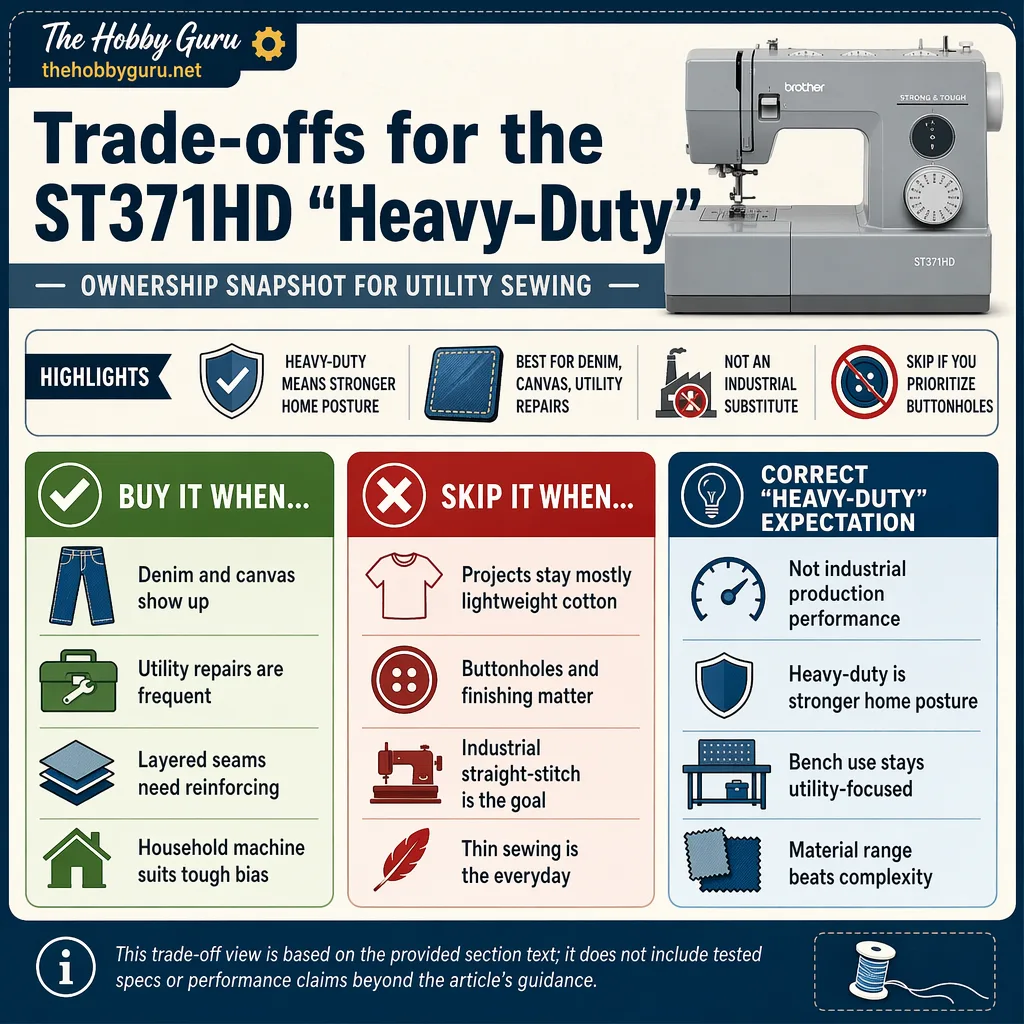
Our Verdict
Buy it when:
- Denim, canvas, upholstery-light repairs, and layered seams show up regularly.
- A straightforward household machine with a tougher bias makes more sense than a feature-heavy model.
- Setup simplicity matters, but not at the cost of material range.
Skip it when:
- Most projects stay in cotton, rayon, or lightweight garment sewing.
- Buttonholes and finish work matter more than sturdy utility stitching.
- A true industrial straight-stitch setup is the actual goal.
The most common mistake is treating “heavy-duty” as a promise of industrial performance. That reading is wrong. In this class, heavy-duty means a stronger home-sewing posture, not a substitute for a production machine or a thick-material specialist.
What We Checked
This is a researched buyer-fit analysis, grounded in documented research and ownership criteria. The focus sits on what the ST371HD is designed to do, where that design matches hobby use, and where the everyday friction appears once the project list gets specific.
Brother ST371HD Review
This Brother ST371HD review centers on workflow fit. The machine matters when the sewing room needs one dependable household tool that leans tougher than a basic starter machine, but still stays compact and approachable enough for regular home use.
The important question is not whether it sews. The question is whether it saves setup time on the jobs that actually appear on a hobby bench. For denim patches, bag handles, and canvas seams, that answer trends positive. For delicate garments, decorative stitch browsing, and frequent button work, the value drops.
Our Research-Based Analysis
The analysis result is clear. The ST371HD makes sense as a utility-first home machine, and it loses ground once a buyer expects broad finesse or industrial stamina.
The constraint worth checking sits in maintenance discipline. Tougher household sewing asks for better thread choice, cleaner needle habits, and more attention to the presser foot and stitch settings. That is not a flaw. It is the real cost of using one machine across mixed materials instead of keeping separate machines for soft fabric and hard-use repairs.
Where It Makes Sense
The ST371HD belongs in a workshop-style sewing setup where repeat utility matters more than novelty. It fits the buyer who wants a machine that stays useful after the first week of excitement has passed.
Best-fit scenario: A home sewing station that alternates between jeans hems, tote bag seams, patch repairs, apron work, and the occasional thicker stack at seams and corners.
Poor fit: A sewing room built around quilting cotton, costume detail work, or frequent buttonholes and decorative stitching.
Ease of Use
Ease of use is strongest when the project is plain and the fabric stack stays sensible. Straight seams, simple repairs, reinforcement stitching, and general household mending fit this machine’s role better than delicate control-heavy work.
The convenience drops when the project demands repeated adjustments. Thick intersections, stiff webbing, and button work push a user into slower, more deliberate sewing. That is the trade-off for a tougher household posture. The machine does not remove operator attention, it just gives that attention a better chance of paying off on sturdier materials.
Ease of Setup
Setup matters more here than on a machine bought for occasional light sewing. A buyer who already understands needle choice, thread matching, and presser-foot swaps will settle in faster than a buyer expecting a plug-and-sew experience.
That is the part many listings gloss over. A sewing machine aimed at heavier hobby use reduces one kind of friction and increases another. It welcomes thicker projects, but it expects cleaner preparation. If the machine lives on a bench and gets used often, that trade-off feels reasonable. If it comes out only for rare repairs, the setup burden feels larger than the value.
Fabric and Project Fit
| Fabric or project | Fit | Why it fits | Trade-off |
|---|---|---|---|
| Quilting cotton | Good, but not the main reason to buy | Handles basic seams and household sewing without drama | A standard all-purpose machine feels lighter and simpler for cotton-first sewing |
| Denim hems and repairs | Strong fit | The tougher positioning matches repeated repair work and thicker seams | Layered areas still demand slower stitching and good needle choices |
| Canvas totes and utility bags | Strong fit | Useful for project sewing that needs sturdier stitch confidence | Thick strap joins and boxed corners need careful feed and prep |
| Light garment sewing | Conditional fit | Works for simple hems and basic seams | A lighter machine gives a smoother feel for softer fabrics and fine finish work |
| Buttonholes and button work | Limited fit | Useful for occasional utility finishing | Button work demands patience, marking accuracy, and a calm setup process |
Where the Claims Need Context
This is the section that keeps the buying decision honest. The ST371HD makes real sense in a utility-heavy sewing room, but the claims around strength and versatility need careful reading.
Button work
Most guides treat button work as a minor feature. That is wrong for a practical buyer. Button work exposes whether the machine supports careful finishing or simply tolerates it.
A machine built for heavier household sewing still asks for precise marking, stable fabric support, and repeatable foot control during buttonhole and button placement work. That matters because sloppy prep shows immediately on collars, plackets, and hems. Buyers who expect effortless button work from a heavy-duty label end up disappointed.
Heavy-duty claim limits
The heavy-duty label separates this machine from flimsy starter models. It does not turn it into an industrial machine, and it does not erase the limits of a home-sewing format.
The mistake to avoid is buying it for thick material stacks that belong on a more specialized setup. Leather projects, nonstop production work, and repeated high-resistance seams all point beyond what a household machine should carry. For hobby use, the better read is simpler: this model stretches the useful range of a home machine, then stops where maintenance burden and motor strain start to rise.
That maintenance burden is a real part of ownership, not a side note. Heavier fabrics, denser thread, and frequent accessory swaps place more importance on clean needles, regular lint cleanup, and the right foot for the job. A buyer who likes a tidy, stable workbench will respect that. A buyer who wants a machine that forgives sloppy prep will feel the friction fast.
How It Compares With Alternatives
The closest comparison is not another flashy feature machine. It is a standard all-purpose home machine on one side and a true industrial straight-stitch machine on the other.
| Option | Best for | Why it wins | Where the ST371HD loses |
|---|---|---|---|
| Brother ST371HD | Mixed hobby sewing, repairs, denim, canvas, utility bags | Better material bias for tougher home projects | Less attractive for button work and light-fabric finesse |
| Standard all-purpose home machine | Quilting cotton, beginner garments, occasional mending | Easier setup, lighter touch, less friction for everyday sewing | Gives up the tougher utility focus that makes the ST371HD interesting |
| True industrial straight-stitch machine | Repeat heavy seams, production-style work, dense material use | Serious consistency for one job type | Brings more cost, more space pressure, and less versatility for normal hobby projects |
A standard all-purpose machine belongs on the shortlist when the sewing room stays cotton-first. That choice keeps setup easier and preserves a softer touch for garments and craft work. The ST371HD wins when the room needs a sturdier utility machine that sees denim, canvas, and repair work often enough to justify the trade-off.
A true industrial machine belongs in a different decision category. It serves a narrower workflow and asks for more commitment in space, setup, and upkeep. The ST371HD looks better when the buyer wants one household machine that stays useful across mixed project types without crossing into workshop overkill.
Constraints to Confirm for Brother St371hd Sewing Machine
This section matters more than a glossy spec page. A buyer gets the best result by checking the exact listing details that shape ownership, not just the model name.
- Accessory package: Confirm the included feet, bobbins, needles, and any specialty attachments. Missing accessories turn a good machine into a frustrated purchase fast.
- Buttonhole method: Verify the exact buttonhole setup on the listing. Button work changes the buying equation more than most shoppers admit.
- Replacement parts path: Check how easy standard Brother accessories are to source. A machine that sees regular utility work deserves simple replacement options.
- Manual and support access: Keep the manual easy to find before the first project. This matters more on a machine with a tougher sewing bias than on a casual novelty machine.
- Used-market condition: A clean used unit with a complete accessory box beats a cosmetically nice machine with missing feet and no manual. On this model class, the accessory gap creates more annoyance than a small scratch on the shell.
The biggest constraint is not the machine body. It is the project ecosystem around it. If the planned work demands specific feet, repeat buttonholes, or a precise path for replacement parts, the listing has to answer those questions cleanly before checkout.
Decision Checklist
Use this as the final filter.
- You sew denim, canvas, or repair-heavy projects more than decorative fabric work.
- You want a stronger household machine, not an industrial setup.
- You keep a small bench or craft corner and want one utility-focused machine.
- You accept a little more setup discipline in exchange for broader material range.
- You do not depend on frequent button work as a core project type.
- You verify the accessory package before buying.
If three or more of those lines do not fit your situation, the ST371HD is the wrong buy. A simpler all-purpose machine belongs in the cart instead.
The Practical Verdict
Recommend the Brother ST371HD Sewing Machine for hobby sewists who repair, reinforce, and build with mixed fabrics often enough to justify a tougher home machine. Skip it for light-fabric sewing rooms, decorative-stitch shoppers, and anyone who wants button work to feel effortless.
The reason is straightforward. This model earns its place through utility, not glamour. It gives a home setup more range for denim, canvas, and repair jobs, but it asks for more care during setup and more patience around button work. That is a fair exchange for the right buyer and a bad one for the wrong buyer.
Frequently Asked Questions
Is the Brother ST371HD a good beginner sewing machine?
Yes, for a beginner who wants utility sewing and plans to learn needle, foot, and tension basics early. It is a poor fit for a first machine if the goal is the easiest possible setup and the lightest learning curve.
Does the ST371HD handle button work well?
It handles button work as a practical task, not as a standout specialty. Buyers who sew buttons and buttonholes often should prioritize a machine with a clearer finishing workflow.
Is it good for denim and canvas?
Yes. That is the most convincing reason to buy this model. Denim hems, bag seams, and other tougher household projects match the machine’s intended lane better than delicate garment work.
What should be checked before buying?
Check the included accessories, the buttonhole setup, and the replacement-part path. Those details shape day-to-day satisfaction more than the model name does.
Is a used ST371HD worth considering?
Yes, if the accessory kit is complete and the machine runs smoothly by hand. A missing foot set or an unclear service history takes too much value out of the deal.
See Also
If you are weighing this model, also compare it with Brother SE600 Sewing and Embroidery Machine Review, Brother CS7000X Sewing Machine Review: Performance, Features, and Results, and Brother CS7205 Computerized Sewing Machine Review: Performance, Features, and Results.
For broader context before you decide, Resin vs. Filament 3D Printing: Head-to-Head Comparison and Janome Memory Craft 400E Review: A Focused Embroidery Machine for Home Use help round out the trade-offs.