Quick Buyer Summary
| Verdict | Best fit | Skip if |
|---|---|---|
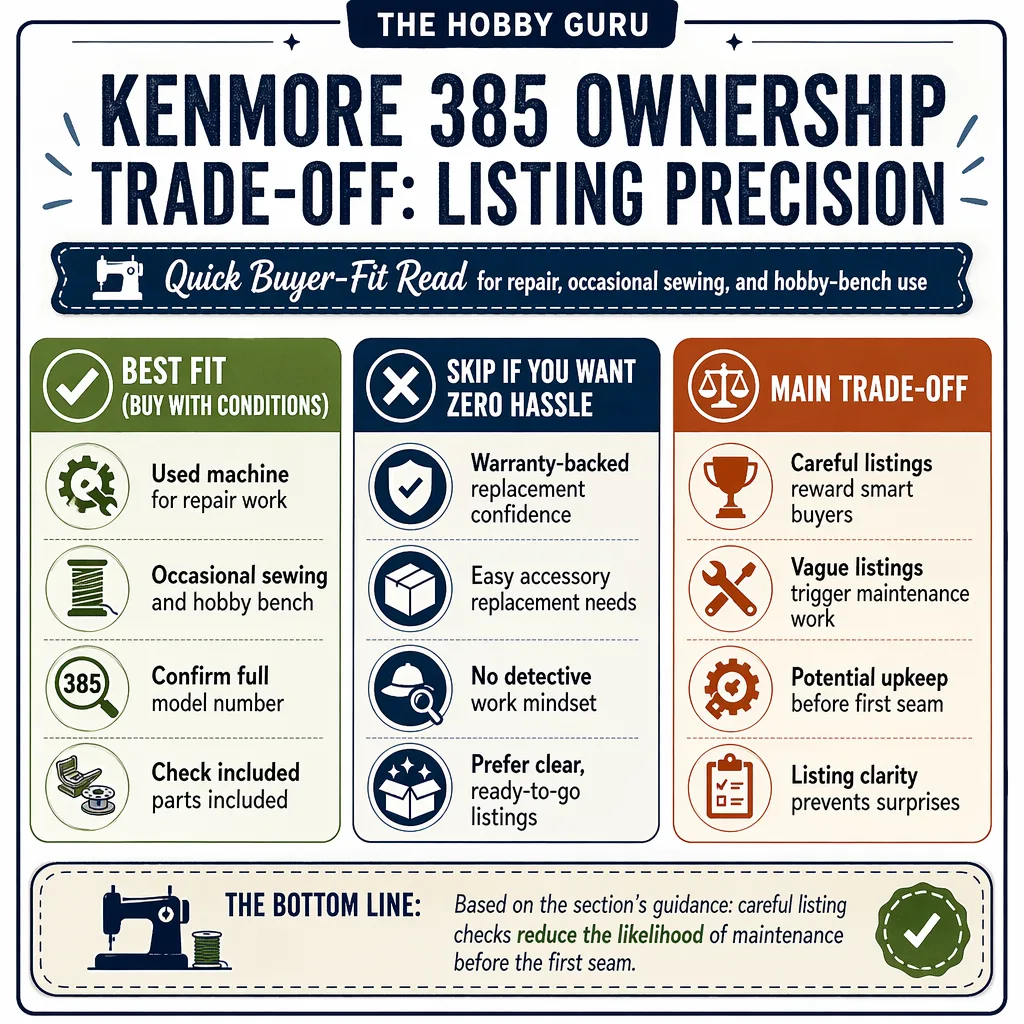
| Buy with conditions | You want a used machine for repair work, occasional sewing, or a hobby bench, and you can confirm the full model number plus included parts. | You want a warranty-backed machine with easy accessory replacement and zero detective work. |
Best for
- A buyer who accepts used-machine checking and wants a solid project helper on a bench or in a sewing cabinet.
- A hobbyist who values model-specific parts hunting less than current retail convenience.
- A collector or maker who wants a Kenmore with the right accessory set and a documented submodel.
Not for
- Anyone who wants to click buy on a listing that only says “Kenmore 385.”
- Anyone who needs a current manual, broad accessory compatibility, and simple returns.
- Anyone who wants a machine that works as a grab-and-go tool with no pre-purchase inspection.
The main trade-off is simple. A good Kenmore 385 listing rewards careful buyers. A vague listing turns into a maintenance project before the first seam.
What This Analysis Is Based On
Most guides flatten Kenmore 385 into one machine. That is wrong because the 385 prefix appears on multiple submodels, and the full number determines the manual, accessory fit, and parts search. The buying decision centers on identification first, condition second, and features third.
Exact stitch counts and bundled feet vary across the 385 family, so the useful question is not “Is it a Kenmore 385?” The useful question is “Which 385 is it, what comes with it, and does the machine prove it can sew cleanly right now?” That structure matters more than a glossy cabinet photo.
This analysis focuses on buyer-fit logic, used-market friction, and maintenance burden. That is where the real cost sits. A complete machine with documented parts stays manageable. A stripped machine with a vague listing becomes a scavenger hunt.
Where It Makes Sense
The Kenmore 385 belongs on a short list when the buyer wants a practical used machine for everyday hobby tasks and accepts a little verification work.
- Basic garment repair and alterations: A complete, working 385 fits hemming, seams, and mending work on the hobby bench.
- Secondary machine for a craft room or workshop: It suits a backup station where the machine can stay set up.
- Used-value purchase: It fits buyers who want to pay for condition and completeness, not showroom freshness.
- Vintage-friendly setup: It works for buyers who want an older Kenmore without chasing a museum piece.
The drawback is the same across all four use cases. The machine only stays attractive when the listing includes the exact submodel, a usable cord and pedal, and enough accessories to avoid immediate replacement shopping. A cheap cabinet model with missing parts stops being convenient fast, because the cabinet adds moving weight and storage hassle if the machine is not staying in one place.
What to Verify Before Buying
A clean outer shell hides more problems than it solves. The full model number matters more than the family label, and a stitch sample matters more than a seller’s promise.
Used-buy inspection checklist
- Full submodel number visible on the machine tag or in the listing photos.
- Power cord and foot pedal included, with no cuts, cracks, or taped repairs.
- Handwheel turns smoothly by hand.
- Presser foot lifts and lowers normally.
- Reverse, stitch length, and any selector controls move without binding.
- Bobbin area is complete, clean, and free of obvious corrosion.
- Needle plate, spool pins, and accessory tray are present.
- Seller shows a stitch sample on woven fabric, not just a running motor video.
Common problems and red flags
- The listing says only “Kenmore 385,” with no full submodel.
- Accessories appear in a bag with no clear list.
- The seller cannot show a sewn sample.
- The machine runs but the reverse function or bobbin area is not shown.
- A cabinet version looks good from the top, but the hinges, wiring, or storage space are damaged.
A lot of buyers focus on cosmetic condition first. That is the wrong order. The machine’s value lives in completeness and proof of operation, because missing feet, a missing pedal, or a missing manual creates the first round of extra cost before the first project begins.
Proof Points to Check for Kenmore 385 Sewing Machine
For online listings, the strongest proof points are the ones that reduce guesswork. A seller photo that only shows the front panel proves almost nothing. A good listing gives you enough to judge whether the machine is a complete sewing tool or a parts donor with a polished exterior.
Look for these four signs:
- Exact submodel photo, not just the Kenmore badge.
- Accessory spread photo, with feet, bobbins, and the manual or cover shown individually.
- Stitch sample image or short video, ideally on medium-weight cotton.
- Close-up of the bobbin and needle area, so missing pieces or grime do not stay hidden.
This is where the workbench mindset pays off. A seller who documents the machine well saves time later. A seller who hides the details forces the buyer to assume the maintenance burden before the box even arrives.
How It Compares With Alternatives
The Kenmore 385 makes the most sense against a new entry-level mechanical machine from Brother or Singer. The trade-off is plain: the Kenmore asks for more verification up front, while a current basic machine lowers the parts-and-manual headache.
Choose the Kenmore 385 when:
- You want a used value buy.
- You can confirm the full submodel.
- You want a machine that can live on a bench or in a cabinet for repeated hobby use.
Choose a current basic Brother or Singer when:
- You want simpler accessory sourcing.
- You want current documentation and easier support.
- You do not want to inspect a used machine closely before buying.
Against another vintage machine, the 385 wins only when the listing is complete and documented. If a different machine comes with clearer parts support, a better photo set, and a known service history, that safer buy deserves the nod. The brand name alone does not override missing proof.
Decision Checklist
Use this as the final pass before buying:
- The listing shows the full Kenmore 385 submodel number.
- The machine includes the cord, pedal, and at least the basic presser feet.
- A sewn sample or demo video proves the machine actually stitches.
- The bobbin area, handwheel, and controls look complete and functional.
- You are comfortable matching future parts by exact submodel.
- You want a used or vintage-style machine, not a current convenience purchase.
If two or more of those points come back as “no,” skip the machine. The bargain disappears quickly once replacement parts, missing feet, or troubleshooting time enter the picture.
Bottom Line
Buy the Kenmore 385 only as a complete, identified, working machine. That makes it a practical choice for repair work, occasional sewing, and a vintage-friendly hobby bench. The sensible upgrade path is a new basic Brother or Singer if easy ownership matters more than used-value appeal.
Skip it when the listing hides the submodel, the accessories are thin, or the seller cannot show a clean stitch sample. That is the clearest split in this purchase: verified completeness earns a recommendation, while vague listings turn the 385 into a maintenance problem.
Frequently Asked Questions
Are Kenmore 385 parts still available?
Yes, but exact availability follows the submodel number, not just the “385” label. Feet, bobbins, manuals, and some replacement parts show up through sewing parts sellers and used marketplaces when the exact variant is known.
Do all Kenmore 385 accessories fit every 385 machine?
No. Do not assume universal fit across the whole 385 family. Match the submodel and the accessory style before buying replacement feet or bobbin parts.
Is a Kenmore 385 reliable enough for regular sewing?
A complete, serviced example fits regular sewing and repair work. A neglected example turns into a repair project. The condition of the machine and the completeness of the set matter more than the badge.
What is the biggest mistake buyers make with this machine?
Buying the “Kenmore 385” label without the full submodel number. That is the fastest way to end up with incompatible accessories, missing documentation, or a machine that looks right but does not prove much.
Should a beginner buy one?
A beginner buys one only when the full listing is documented and the machine is complete. A current machine with simpler support fits a beginner better when the goal is less setup friction and easier replacement sourcing.
See Also
If you are weighing this model, also compare it with Janome Memory Craft 9850: What to Know Before You Buy, Brother LS14S Sewing Machine Review: Key Things to Know Before You Buy, and Craftsman Electric Pressure Washer Review: Performance, Features, and Value.
For broader context before you decide, Best Scissors for Fabric Cutting in 2026 and Janome Memory Craft 400E Review: A Focused Embroidery Machine for Home Use help round out the trade-offs.