The Brother Xr3340 Sewing Machine is a sensible fit for hobby sewing that mixes repairs, garments, and light quilting. That answer changes fast if the work leans into thick denim, canvas, or upholstery, because convenience-focused machines lose their appeal when the fabric stack gets stubborn. It also changes if the machine has to come out of storage for every session, since this model earns its place only when setup stays easy and repeatable.
The Short Answer
The XR3340 makes sense for buyers who want a feature-rich home machine without jumping into a bulky, specialist setup. It suits mixed projects, frequent thread changes, and the kind of sewing room that stays organized enough to support a few accessories and a decent amount of bench space.
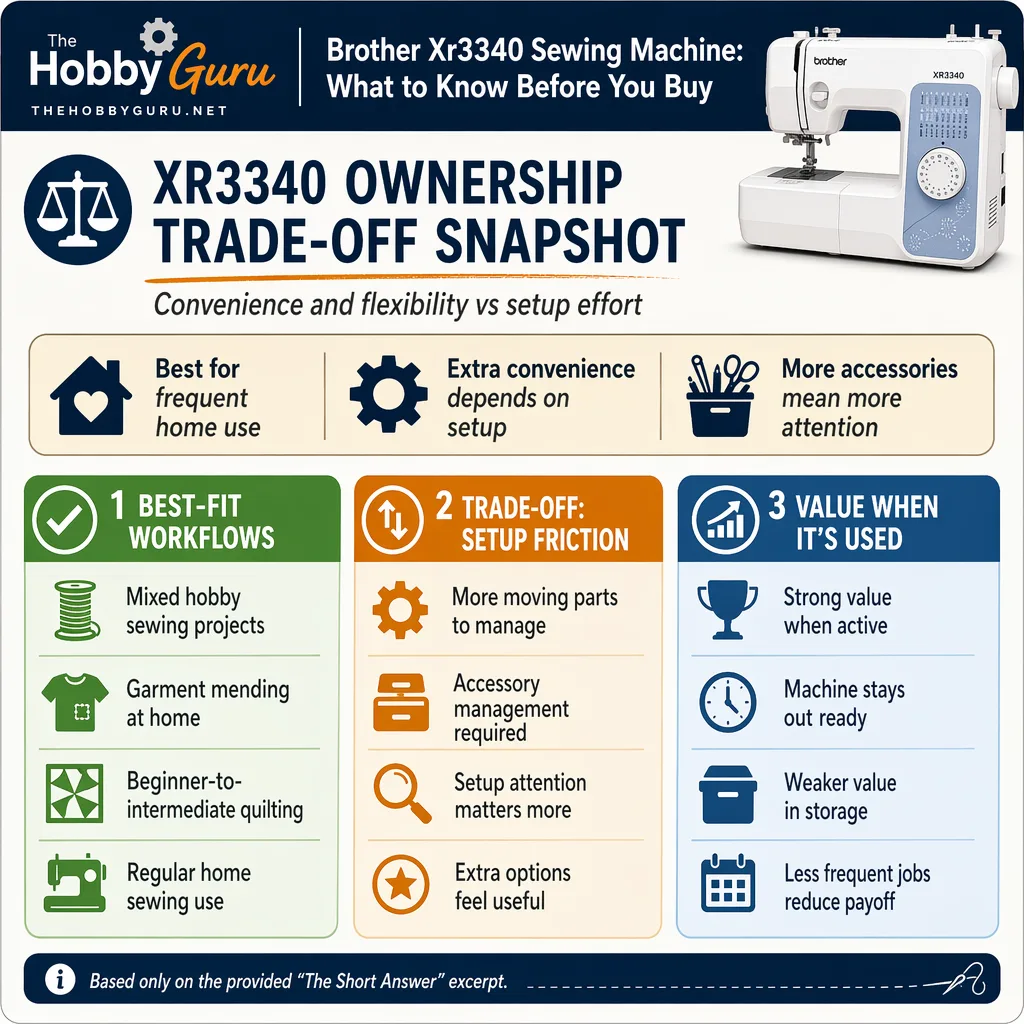
The value is not brute force. The value sits in convenience, flexibility, and a workflow that stays friendly after the first project is over. Most guides rank stitch variety first, and that is the wrong order here. Setup friction decides whether those extra options feel useful or just decorative.
Quick verdict
- Best fit: mixed hobby sewing, garment mending, beginner-to-intermediate quilting, and regular home use
- Main drawback: more moving parts in the decision, more accessory management, and more setup attention than a plain mechanical machine
- Value read: strong when the machine stays out and gets used often, weaker when it sits in storage between occasional jobs
What We Checked
This analysis centers on buyer fit, grounded in documented research. The useful questions are simple: what kind of sewing does the XR3340 support, how much setup friction does it create, and what does the owner give up in exchange for convenience features?
The decision lens here is workflow first, then maintenance burden, then value. That matters because a home sewing machine is judged by repeat use, not by the moment it comes out of the box.
What that means in practice:
- Workflow fit: does the machine match mixed hobby tasks, or does it feel overbuilt for simple mending?
- Setup friction: how much threading, accessory sorting, and stitch selection stands between the project and the seam?
- Maintenance burden: how much routine cleaning, needle changing, and organization does the machine demand?
- Purchase risk: what gets missing on bundle listings, used machines, or seller pages with thin detail?
Where It Makes Sense
The XR3340 belongs on the shortlist when sewing work moves between several task types. It fits a room where one week brings hemming, the next brings bag linings, and the next brings piecing or decorative finishing. That flexibility carries real value because it cuts down on tool swapping.
Best-fit scenario
You want one machine for regular hobby sewing, light quilting, garment repairs, and classroom-style project work.
You have enough space to leave it set up, keep accessories organized, and tolerate a slightly busier control layout than the simplest entry-level machines.
Skip this if
- Most of the work is thick denim, heavy canvas, or upholstery
- The goal is the simplest possible machine with almost no learning curve
- Storage stays tight and the machine has to be packed away after every use
- The buying plan depends on a very specific accessory bundle that the seller does not spell out
Where the Claims Need Context
The XR3340 reads best as a convenience machine, not a tough-fabric specialist. That distinction matters because some buyers shop by stitch count or feature lists alone. That is a mistake. Features only help if the owner uses them often enough to justify the extra setup and storage burden.
| Decision point | What helps | What to verify |
|---|---|---|
| Stitch variety | Useful for mixed home projects and finishing work | Buy only if those extra stitches match real projects, not wishlist shopping |
| Accessory bundle | Raises value when the listing includes the right feet, bobbins, and support pieces | Check the full box contents before checkout, especially on open-box or used listings |
| Storage and setup | Fine for a sewing room that stays ready | Expect the machine to feel less attractive if it has to be assembled and put away often |
| Fabric range | Good for everyday sewing and light project work | Move to a heavy-duty machine if stacked seams or dense materials dominate the work |
Common complaint themes
Recurring buyer feedback centers on friction, not shock failures. The usual complaints are easy to understand:
- Threading feels fussier than expected when a buyer wants a dead-simple machine
- The accessory bundle varies by listing, which turns bargain hunting into homework
- The machine does not satisfy people who want heavy-fabric power first and convenience second
- Extra features lose value when the owner only sews occasionally and forgets the settings between sessions
The maintenance reality matters here. Fresh needles, a clean bobbin area, and organized accessories do more for satisfaction than any spec sheet line. Skip those basics and the machine starts to feel more complicated than it is.
Where Brother Xr3340 Sewing Machine Is Worth Paying For
The money goes toward repeat-use convenience. That is the real selling point. A machine like this earns its keep when the user moves from one kind of project to another without relearning the setup every time.
That matters in a busy hobby bench where fabric, tools, and project parts already compete for space. If the machine stays out, the extra capability feels justified. If it lives in a closet and comes out for the occasional hem, the convenience premium stops paying back.
A secondhand note matters here too. Used listings lose value fast when they omit the foot pedal, power cord, presser feet, manual, or extension pieces that make the package feel complete. On a simpler mechanical machine, those gaps hurt less. On a feature-rich model, they erase part of the point.
How It Compares With Alternatives
A basic mechanical Brother belongs on the shortlist if the work is mostly straight seams, mending, and low-drama sewing. That style of machine wins on simplicity and loses on range. It gives up flexibility, but it also removes a lot of setup thinking.
A heavy-duty sewing machine belongs on the shortlist if thick denim, canvas, or layered seams define the project pile. That choice wins on fabric aggression and loses on refinement. It gives up some of the easy hobby-room comfort that makes the XR3340 appealing.
Shortlist logic
- Choose the XR3340 for mixed hobby work, light quilting, and regular use with a little more convenience
- Choose a simpler mechanical machine for occasional repairs and the lowest possible learning curve
- Choose a heavy-duty machine for thick material and rougher construction work
The wrong way to shop this category is to assume more features always equal better value. That is false when the machine will not stay set up long enough for those features to matter.
Decision Checklist
Use this as a quick buy-or-skip test:
- You sew more than one type of project
- You want convenience features to save time between projects
- You have a stable place for the machine and accessories
- You care more about easy workflow than maximum fabric force
- You will verify the full bundle before buying
- You do not need an industrial-style answer to heavy layers
If four or more of those are true, the XR3340 fits the job well.
Bottom Line
Recommend the Brother XR3340 for mixed home sewing, light quilting, and buyers who value convenience over brute strength. It works best when the machine stays out, the accessories stay organized, and the owner uses the extra capability often enough to justify the added complexity.
Skip it if thick fabric is the main job or if the machine will spend most of its life packed away. In that case, a simpler machine or a heavy-duty alternative fits better. The XR3340 earns its place through workflow comfort, not raw power.
FAQ
Is the Brother XR3340 good for beginners?
Yes, for beginners who want room to grow. It fits new sewists who plan to keep sewing and want more than a bare-minimum machine. It does not fit someone who wants the simplest possible first machine with almost no extra decisions.
Does the XR3340 make sense for quilting?
Yes, especially for light quilting and piecing work. The machine belongs in a sewing room that handles fabric layout, occasional larger pieces, and projects that benefit from extra convenience. It loses appeal if the workspace is cramped or the bundle leaves out the accessories that support quilting work.
What should be checked before buying used?
Check the foot pedal, power cord, presser feet, bobbins, manual, and any extension or specialty pieces included with the listing. Also check that the needle area and bobbin zone move cleanly and that the seller spells out the condition clearly. Used machines lose a lot of value when the accessory pack is incomplete.
Is it a good substitute for a heavy-duty machine?
No. A heavy-duty machine belongs on the shortlist when thick denim, canvas, or stacked seams are the daily job. The XR3340 fits better for mixed hobby sewing and lighter project work where control and convenience matter more than muscle.
Why do some buyers find feature-rich Brothers frustrating?
Because extra choices create extra setup responsibility. When threading, bobbin loading, or stitch selection gets rushed, the machine feels fussier than it should. The fix is not mystery, it is disciplined setup and keeping the machine clean and organized.
See Also
If you are weighing this model, also compare it with What to Check When Buying a Magnifying Lamp for Crafts, How to Choose the Best Magnifier for Hobby Painting, and Brother SE600 Sewing Machine Review: A Practical Look at a Versatile Combo Machine.
For broader context before you decide, Embroidery Starter Kit for Beginners: Buying Guide and Janome Memory Craft 400E Review: A Focused Embroidery Machine for Home Use help round out the trade-offs.